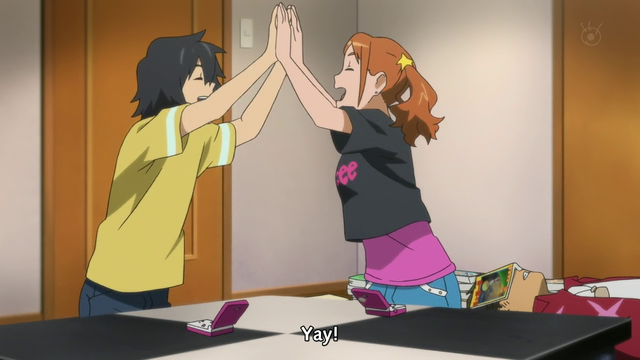
Ano Hi Mita Hana no Namae wo Bokutachi wa Mada Shiranai (We Still Don’t Know the Name of the Flower we Saw that Day, or Ano Hana) begins with Jinta, a hikikimori and soon-to-be high school drop out, meeting the ghost of the girl he loved as a child, Menma. In a fit of youthful passion, he told her she was ugly and ran off, and she died before he could meet her again. Menma’s return leads Jinta both to reunite with his other childhood friends in their efforts to grant Menma’s wish so that she can be reincarnated, and to confront their own pasts.
Ano Hana’s greatest strength lies in its impeccable characterizations and emotionally charged script. All of the characters are both sympathetic and deeply flawed. Each of them gets their chance in the spotlight and makes strides towards overcoming their weaknesses, although no one fully resolves all their problems by the end of the story. The side characters also have a chance to shine, particularly Menma’s family. The story is quite emotional, with many tearjerk moments. Expect to cry multiple times while watching Ano Hana.
For me at least, part of the appeal of Ano Hana is the nostalgia factor. As high schoolers, Menma’s friends have a chance to return to their secret clubhouse and to trade Pokemon. I had my own trip down memory lane and returned to the secret clubhouses of my past. Mine was inside a pine tree, so I wasn’t quite as spoiled. (Back in my day, we walked ten miles to school through the snow everyday and it was uphill both ways… but I digress.) It makes for an interesting setup to see high schoolers interacting with their friend who hasn’t grown up and is still a child.
I don’t particularly have anything negative to say about Ano Hana: it perhaps didn’t have the most ambitious plot, but its superb execution and characters more than make up for this, and the simple story becomes one of its strengths, with only eleven episodes to spare. Ano Hana, for me, was the highlight of the season, and it comes highly recommended.
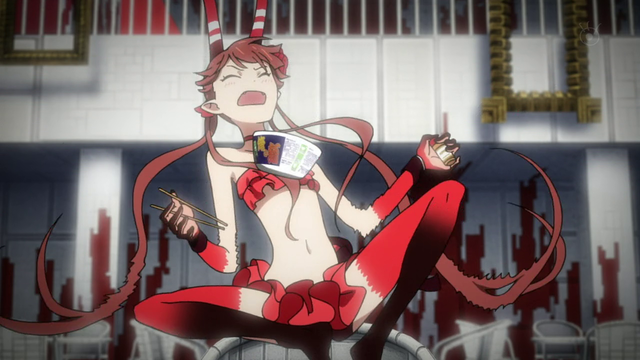
[C] tells the story of Kimimaro, a college student who is invited to the Financial District, an underground world where entrepreneurs and their Assets fight one another for money, with their futures as collateral. It’s a unique and creative premise, and one that should have made for an engrossing story: but unfortunately, the setting is never developed fully, resulting in inconsistencies and a crippling reliance on deus ex machina.
[C] makes heavy use of economics jargon, but it doesn’t have much meaning attached. Let’s take the titular C as an example: it ends up being a name for the wave of economic destruction following the collapse of the economy in a financial district. And the creators take the wave part quite literally, as it takes time to travel to its destination. What the wave is or what it does is never really discussed, aside from it destroying the economy. Then when the wave reaches America, the creators decide to give America “super entrepeneurs” so their head clown bounces the wave back to Japan (no I am not making this up). Then when it gets to Japan the second time it has no effect because the Yen is now worthless. If you think this doesn’t make sense because I’m taking it out of context, I can assure you that it will only make less sense once you’ve watched the show.
The second biggest problem I had with [C] is that half the show is dedicated to the main character getting lectured about which is more important: the present or the future. I found this dichotomy mind-boggling: you can choose one or the other? Needless to say, all of this “deep” philosophical discussion was lost on me.
[C] also suffered from a general lack of focus. We started out focusing on Kimimaro’s school life and the girl he had a crush on, but then they more or less forget about her. There are several random side stories about weekly battles and people losing their future, which were some of the best episodes, but they added little to the main characters or the story. There’s lots of Kimimaro getting lectured about the present or the future being better than the other. Kimimaro’s asset begins to become more human. Then she falls in love with him (one of the worst, most underdeveloped romances I’ve seen) and turns out to be his sister. There’s something about his dad once being an entrepreneur too, but that’s swept under the rug. Nothing really ended up coming together. The creators had a bunch of ideas, but didn’t follow through with them or seem to know where they were headed.
The last problem I’ll mention is the characters. The side characters are fine, but the three lead characters— Kimimaro, his asset Mashu, and his mentor / rival Souichiro— are shallow and annoying. Mashu just sits around inside a credit card for three quarters of the show. In the first episode, they focus on Kimimaro’s need for and pride regarding money, and he seems like an interesting character. But then they ditch all that and make him as generic and lifeless as possible. Basically all he does from episode 2-9 is listen to people lecture him, until in the second to last episode he makes a decision and chooses the future (whoo!). As for Souichiro, he’s consistent, but consistently dull. He mostly just lectures Kimimaro about why the present is the best, and walks around handing out bundles of cash to politicians.
I found [C] to be a disappointing addition to the noitaminA timeslot. I’m notalone in my disappointment, but otherpeople loved it (with reservations) so you may still want to give it a shot.
Plot / Script – 6 / 10 – Lack of depth, total reliance on deus ex machina.
Characters – 7 / 10 – The three main characters are shallow and annoying- the others are ok (probably since we see less of them).
Production – 8 / 10 – Unique style in the financial district, but the animation quality is inconsistent.
Overall – D+
Recommendations – Eden of the East, Stein’s; Gate, Noein
In an unexpected twist, it turns out that Menma’s wish was to make Jinta cry. I didn’t see that one coming. What a mean bully! (she’s so cute though, so we’ll forgive her!)
This last episode wasn’t quite as strong as the previous one, but that’s a difficult standard to match. It was a good conclusion, which managed to wrap everything up nicely. My only quibble is that it was a bit too head-on. For a series which has been strong at the interactions and gradual growth of relationships between characters, this episode wasn’t the most subtle. There was also a bit too much wailing and bawling for me. Still, overall a superb episode.
Most of the crying did pay off, as all of the characters managed to reconcile and become friends once again. One of the parts I enjoyed most was observing the renewed friendship between Jinta and Yukiatsu. Yukiatsu confessed his jealousy of Jinta, Jinta confessed his wanting to keep Menma to himself, and Yukiatsu called Jinta the leader once again. It’s somewhat surprising in retrospect that Yukiatsu managed to be both a crazy crossdresser and one of the most sympathetic characters.
The creators also did a nice job of brining the high tension down a few times during the episode. Jinta commenting on Anaru’s double eyelash was so out of place I couldn’t help but laugh, and I found what turned out to be Menma’s wish hilarious. The wish was a great fit though, and tied everything together: Menma, Jinta’s mother, and Jinta’s own growth. I suppose it could also explain why Menma could only speak with Jinta, although I don’t think any explanation is necessary. Menma’s cards were also quite touching, especially the one for Jinta.
Ano Hana ended up being a worthy successor for Hourou Musuko’s noitaminA timeslot. It’s been one of my favorite show of the season, along with Hyouge Mono. Next season the timeslot will be hosting shows from Bones and Production IG, so I have high hopes.
This was an exceptional episode, in that it managed to make the rest of the series look decent by comparison. It was plagued by the same problems that the rest of the show has suffered from: it’s filled with preaching about solutions to nonexistent problems, such as the great present vs. future debate, and the setting doesn’t make any sense. This episode was filled with deus ex machina like no other.
Let’s take it from the beginning. We start with a battle between Kimimaro and Souichiro. It was probably the most poorly animated battle in the show, and also the least interesting: there weren’t any cool powers or anything. The battle consisted of Kimimaro and Souichiro hitting each other with swords and screaming about how they’ll protect the people dear to them while asking if the other understood now. Unsurprisingly, no one understood because their entire argument was pointless. I think Kimimaro got cut and half at some point, but then the creators forgot. Mashu and Q fought at the same time and argued about what Souichiro’s sister would really want. The only enlightening nugget I gleaned from the entire battle was when Q told Mashu “I don’t care.” Motion seconded.
The most well-animated part of the fight.
While the battle is ongoing, everyone panics and the Japanese Yen becomes worthless. Because of this, everyone can see the Midas money, and it becomes worthless too, for reasons that should be obvious. Of course, this causes Q to transform into Souichiro’s sister and Souichiro has a flashback. Then, as one would logically expect, the C wave hits Japan a second time and has no effect. For reasons that are well explained, the financial district shuts down. In case you couldn’t tell, I was being sarcastic.
The battle is a draw. Kimimaro reverses the printing press and the future comes back. Kimimaro and Mashu share a long (incestuous?) kiss, as some corny music plays in the background.The corny music plays for a really long time. The credits roll. Everyone is happy. Yay.
Kimimaro sees the happy children and his one-sided crush in the park. Everything is well with the world. Oh, and Japan became the 51st state and started using the dollar, because that would totally solve all their economic problems. The clown meets Kimimaro and invites him to come to the financial district. The clown will always be there when there is a future to take as collateral. *tear* Kimimaro looks at the picture he took with Mashu, Q and Souichiro after their battle. He mentions that he forgot to smile. The End.
Overall, C was a very disappointing showing for noitanimA. It had a creative setup, but executed it in such a way that the setting became a liability rather than an asset (ha ha ha ha ha) since it was fraught with deus ex machina, inconsistencies and half-baked ideas.
Those are some crazy compression ratios. Hey, CERN, want to give me access to the LHC? Then I can store petabytes of anime on a floppy disk!
Steins; Gate has been one of my favorite shows this season, with some great characterization and by far the wittiest, best directed dialogue in any recent anime. That’s why what happened this week’s episode was entirely unexpected: the creators completely blew the previous episodes out of the water. Not only did this episode continue (or even surpass) Steins; Gate’s well established trend of spectacular dialogue, but the plot took a tremendous leap forward as well.
And boy does the shit hit the fan hard (spoilers): the lab gets stormed by CERN, led by Moeka, and she murders Mayushii. I speculated before that Moeka was with CERN, but I definitely didn’t expect her to go far as killing Mayushii. I have no doubt that Mayushii will return— this is a show about time travel, after all— but this still hit hard, especially in a show which has been so peaceful up till now, with the exception of the first episode.
There are three big questions that this episode raised for me (and my most recent conspiracy theories are included).
What is special about Mayushii? Mayushii, although she initially seemed to be one of the most straightforward characters, is now the person most deeply enmeshed in enigma. I mean, the intro to this episode was a conversation about her chasing Okabe which took place before mankind even existed (although it seemed like Okabe’s dream). But there is definitely more to her than meets the eye. She has been with Okabe since he was a child, and we know that Okabe had also opened Steins; Gate at that time. I’m led to wonder whether Steins; Gate or even the time travelling microwave are products of Okabe or science, or whether Mayushii may turn out to be the one responsible.
What is part-time warrior up to? She claims she is searching for her dad, which may be true, but there is clearly more to her than that. In this episode we learned that she knows of Christina’s work with CERN through a prophecy— which sounds like a perfect word to describe the memory transfer procedure Christina just invented — and she also realized that CERN was going to attack the lab and escaped. It seemed that she was hesitant to abandon them though.
I’m thinking that John Titor might be associated with CERN, since he and Moeka were both searching for the IBN 5100. But come to think of it, part-time warrior’s dad wasn’t John Titor, but Barrel Titor. Perhaps Moeka is John Titor, and is part-time warrior’s mother. Now who is her father? Well, part-time girl was heading to the time travel forum to meet her father. Who else was going to go but cancelled due to changes in the timeline? Daru. And we already know that Daru has the hots for Moeka. Of course, this entire discussion presupposes that part-time girl was born in the future, which, according to Christina’s theories, is impossible. But there doesn’t seem to be a rule that memories have to be sent from and to the same person.
What is CERN‘s goal? Interestingly, CERN only decided to interfere when Okabe decided to stop messing with time travel. It’s possible that this could be a timely coincidence with the memory transfer device’s completion. But transferring memories doesn’t seem much more dangerous than sending cellphone messages, especially when Okabe already has been transferring memories (of which CERN is no doubt aware through their eavesdropping). The more likely explanation is that CERN is concerned about time travel being made public. They appear to have even greater capabilities than Okabe, with the ability to even stop time. It seems that Christina’s theories are not the end of the story.The other interesting point is that Moeka shot only Mayushii, which leads back to my first question. Mayushii knows absolutely nothing about time travel, so she is the person they have the least reason to kill. Of course, it’s possible they want to interrogate the others first or use them. But both Okabe and Daru understand about as much of how time travel works as Mayushii. Which leaves Christina as the only valuable person from this perspective. Which leads me to reach the opposite conclusion: that Mayushii was killed because she is in fact the most dangerous lab member in the eyes of CERN.
The face of denial.
In addition to the exciting plot developments which will inspire all anime fandom to have fun creating conspiracy theories, the dialogue in this episode continued to be topnotch. As just one example of this show’s masterful use of dialgoue, let’s take a look at the conversation between Okabe and Christina on the bridge while heading home from grocery shopping. While they talk about the decision to reveal their invention to the world, Christina worries that they won’t have time to meet her father. To which Okabe replies, “I’ll solve all my lab member’s problems” and calls Christina his dear companion. This was after Okabe decided not to use the memory transfer device. At this point, I was wondering if CERN hadn’t replaced Okabe with a clone. What happened to his mad scientist act?
But then, to Okabe’s surprise, Christina said “Thank you”, and Okabe became blustered and confused, and tried to check her temperature because she was saying “un-assistant-like things”. Then Christina denies being a tsundere in a very tsundere way, and asks what’s wrong with Okabe for saying such weird things. So my point is, Okabe acts completely out of character for the beginning of this episode, but the dialogue makes it seem perfectly natural: because the other characters realize that he’s acting out of character. This is one way to make your characters take unexpected actions and also appear even more consistent.
To make what Okabe said earlier even more believable, they bring it up again a few minutes earlier: after Christina begins to cook, Daru asks what happened to solving all his lab member’s problems. Another pro-tip which anime creators often forget: viewers have memories longer than ten seconds. Make use of them. I also love it when shows can do a convincing job of inerleaving the serious and comedic elements, which this scene was a shining example of.
I look forward to hearing your conspiracy theories in the comments. No spoilers from the visual novel, please.