Hitsuji no Uta Review — 8.5 / 10.0

Hitsuji no Uta (Lament of the Lambs) is a short OVA from eight years ago. It tells the story of a high schooler named Kazuna, who is reunited with his sister whom he hasn’t seen since he was three years old. The two have a hereditary vampiric disease where they desire blood, and begin to live together as a family, pushing away their friends and Kazuna’s adopted family.

The creators did a good job at building a tense, dark atmosphere. The colors in the animation are used to especially good effect. There are no people with random blue, green and pink hair colors here: everything is dark shades of black and brown. The character designs actually look like real people and not animified. They even have freckles and hair that could conceivably grow on a human head.

On the negative side, the use of flashbacks was a bit much in the first two episodes. The final episode was much stronger than the first three, if only because a lot more happened then. The doctor is just kind of hanging around for the first three episodes, but he really becomes an interesting character in the final episode. Revelations from the final episode also make you see the sister and the family in a quite different light. This is probably more a reflection of how good the final episode and its build up were than any issue with the earlier episodes.

  • Plot / Script – 8  / 10 – A strong storyline, but plot and dialogue repeat themselves a bit much especially with flashbacks
  • Characters – 9 / 10 – The main character’s choices particularly regarding his family could have been better explained. The sister and doctor are very interesting characters, although their stories aren’t revealed until the end.
  • Production – 9  / 10 – Good use of color, although looking aged now.
  • Overall – 8.5 / 10

Recommendations – Ghost Hound, Tsukihime

Toshokan Sensou Review — B-

In the world of Toshokan Sensou (Library Wars), the national government has established a censorship law which the armed Media Cleansing Committee enforces by burning books. In response, the provincial governments have created the Library Force to protect books from censorship in libraries. Toshokan Sensou follows Kasahara as she joins the elite Library Task force.

The show is a mashup of Fahrenheit 451 (more on this later), a war show, and a corny romance. The romance wasn’t actually that bad, I’m just not really into that kind of thing (from the Tatami Galaxy: “There’s nothing more boring than a successful romance”). The military parts of the show were well done, with good action scenes.

The setup is certainly creative, but isn’t entirely believable. Japan has laws which allow open warfare between their own countrymen in open daylight. How could anyone possibly tolerate this? I mean, I think most people would prefer either censorship or no censorship to open warfare in the streets. There were a few other things that didn’t make much sense: for one, we had a pacifist who refused to resist the censors. Then when she is going to get fired from her job she picks up a pistol, shoots someone, and lights herself on fire with her own library. So much for pacifism. So the show requires some suspension of disbelief, but this isn’t too much of a problem.

Now for the Fahrenheit 451 comparison. This show includes references to Fahrenheit 451 as the “Book of Prophecy” which predicts book burning. But unfortunately, this show isn’t really much of a critique of censorship like Bradbury’s book. The reason the main character joins the Library Force is because her “Prince” was in the Library Force and protected her book. The commander founded the Library Force because his wife was killed by the censorship force. And most of the censorship forces are mercenaries (except for the one character with the cleansing committee who has a face, who has “personal connections” and also dislikes censorship). So the censorship forces are rather unambiguously evil. Also, in Fahrenheit 451, the government was more or less just expressing the will of an empty society in burning books: in Toshokan Sensou, most people either support the libraries or are indifferent. (Ok, they claim a majority of people support censorship at some point, but we never even meet any of these people, if they actually exist)  So there is a clear boogeyman in Toshokan Sensou, while for Bradbury the entire society was to blame.

One of the things that made Fahrenheit 451 great is how it showed the effects of censorship on a society and how devastating and hard escape from they are. But here censorship is more of an abstract thing which makes people get shot, or gets some little kids’ books taken away. For a show which is about the suppression of ideas, there are far too few ideas to go around.  Another problem is that the world is static: Montag and his world become more and more interesting as he uncovers more about it and learns to despise what he used to be. In Toshokan Sensou there is no growth. The world more or less is and remains the way it initially appeared.

Still, overall I greatly enjoyed this show— it’s completely unfair to compare it to one of Bradbury’s masterpieces. One of the more interesting aspects for me was seeing the cultural political differences. Americans tend to be less ambivalent about censorship than most of the world, for one thing, although we certainly have our fair share of censorship advocates. A lot of Western works focus on censorship as well, but the same can’t be said of anime. The ending of the show also felt extremely Japanese: after something that wasn’t really his fault, the commander of the Library Forces tragically steps down to “take responsibility”, as the rest of the forces honored him. This took most of an episode with much crying. I was kind of just rolling my eyes.

  • Plot / Script – 9  / 10 – Creative setting, interesting short stories
  • Characters – 8  / 10 – Distinctive and enjoyable, although small in number
  • Production – 8 / 10 – Consistent, nothing spectacular
  • Overall – B-

Recommendations – Planetes, Nodame Cantabile (for the romance), Book of Bantorra, Read or Die (for the books)

C: The Money of Soul and Possibility Control 06 — …*sigh*…

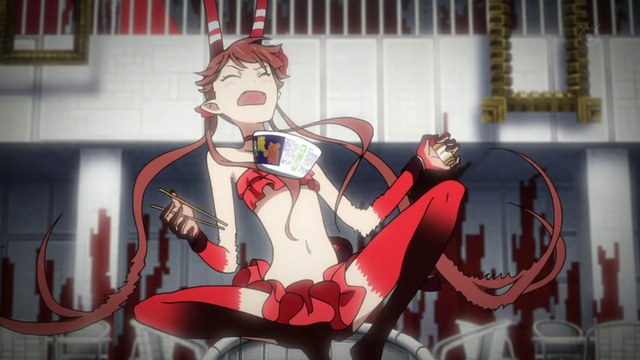
I have no idea what the creators were thinking with this episode. Let’s start with the beginning. After Mashu and Kimimaro’s poor communication skills led to their defeat last week, they begin this episode with perfect teamwork and knowing their opponent. All of their cooperation issues from the previous episode are resolved. This could have been a good opportunity to develop Mashu’s character, whose most notable trait is that she likes ramen. But we skip all of that development and jump straight to the result. Well, it’s a short series, so maybe they didn’t have time.

Except then the next twenty minutes are spent with three different people spouting gibberish at Kimimaro (and sexually assaulting him). I honestly have no idea what the point of this was or even what their disagreement was. Something about Souichiro fighting for the present, IMF girl wanting to destroy the root of the problem, and the other guy fighting only for the future. I’m not sure how their actual plans result in these things though. Kimimaro has a big decision: let the other guy forfeit on his behalf, or fight it out. Here’s a brilliant idea for the two of them: instead of paying money to forfeit, why don’t you both just stand there and do nothing?! That would make everyone happy. But no, Kimimaro, genius that he is, decides after all of this discussion, that he must fight and win. And he proceeds to (apparently) bankrupt the guy, the one outcome that every single person wanted to avoid.

I say apparently because they skipped the only potentially interesting part of the fight. They had Mashu get beat up and bleed her black blood all over the place. Then she and Kimimaro hold hands, scream at the top of their lungs and walk forward into the light of battle… only to immediately skip over to the aftermath.

Somehow, we have romantic hints being dropped between Kimimaro and Mashu this episode, which came completely out of nowhere. I guess we can forgive the creators for this one, since we probably would have noticed if the two main characters didn’t have a net personality less than a block of wood’s. Also the IMF woman has transformed from one of the more interesting characters into a complete joke of fanservice fodder and fast food.

Overall I’m rather disappointed in the direction that C has taken. It has an interesting premise… but it hasn’t fleshed it out well, isn’t making the best use of its time, and the characters are completely uninspired. It took over from Fractale this season in more than just its timeslot.

Ano Hana 06 — Booty Calls and Nosebleeds

This was another emotional episode of Ano Hana. Everyone is having difficulties and working to overcome them. Anjou is facing rumors at school that she’s a prostitute, Jinta works up to courage to go to school, only to defend Anjou and run away, and Menma is worried about her mother. Poppo seems lonely, Tsurumi faces jealousy at school because of her relationship with Matsuyuki, and Matsuyuki is still trying to get over the past. I particularly enjoy how Ano Hana presents all these issues at once: we don’t have one episode focusing on Anjou, one on Tsurumi, etc., but all their problems are intertwed. Jinta, in overcoming his own fear of school helps Anjou face the rumors

My favorite scene in this episode was when Menma was crying and telling Jinta not to see her mom, and then Jinta got a nosebleed. It just seemed like a perfect release for all that built-up steam. It was anti-climatic and completely unexpected, and served to show the turbulence and uncertainty behind both Jinta and Menma’s feelings. Menma is yelling at Jinta, but then she immediately forgets about it and starts stuffing him with tissues when his nose starts bleeding. It also serves as a reminder that she’s still a child. And Jinta likewise goes from angry at Menma, to surprised his nose is bleeding, to blushing and running away when she jumps on top of him. The return of his nosebleed when he saw Anjou again was a nice touch too.

Hidan no Aria 06 — Shirayuki, Miko Newlywed Childhood Friend

This episode focused on Shirayuki and trying to see how many annoying cliches  the creators could stuff into a single character. This seems to have become popular lately (the example that comes to mind first is Kore wa Zombie Desu Ka?!, but I know that other examples precede it). The creators seem to say: oh, there are so many mikos lately, that’ll be boring. There are too many childhood friends too, we can’t have one. And everyone has the obsessive wanna-be newlywed. But I have a brilliant idea! Let’s make a character that’s all of these at once! No one’s ever thought of that before!

The only problem is that this only serves to make the character triply annoying. Now Zombie had the same idea at a high level: let’s combine a newlywed and a vampire and a ninja, or a zombie with a magical girl. But that worked because it was funny. A male zombie magical girl is WIN. A miko newlywed childhood friend is a triple fail. That’s not to mention her tragic past, isolated by her parents and bullied by everyone at the temple (yet another cliche…). Or how she’s a damsel in distress needing bodyguards. Or how she has supernatural powers. Still, I should point out that despite all her baggage, Shirayuki still annoys me much less than Aria.

The pacing was pretty terrible in this episode too. Kinji is watching Aria and Shirayuki fight as they rip his apartment to shreds. Then he leans back against the wall and has a flashback of how he knew Shirayuki as a child. Way to dump all the excitement out the window.

This episode was terrible enough that I think I will continue to blog it. It certainly gives me plenty to complain about.