Tag Archives: anime

Mardock Scramble: The First Compression Review — A-

I went into this movie with no expectations whatsoever, and came out blown away. If you see only a single movie this year, make it this one.

Mardock Scramble begins brutally, with the rape and murder of a young girl, Balot. I thought at first that Balot would just be a throwaway character to introduce our heroic detective and evil villain, who would be the lead characters in a fast-paced action show. I couldn’t have been more wrong. Mardock scramble turned out to be a deeply introspective film examining Balot’s past.

Balot

Balot is one of the most interesting characters I’ve seen in a while. Her first line in the film is “I wish I were dead.” When she is brought back to life, she is asked to visualize what she most wants, and a gun appears in her hand. The doctor assumes that Balot wants revenge against her murderer. But then Balot sets the barrel to her own cheek and pulls the trigger.

Suffice to say that Balot is a very broken person. Half of the movie takes the form of a walk around town with Oeufcoque, an AI who helps reveal her past, with interspersed gun fights and car chases. Initially, Balot is afraid to go to court because her past and her shame will be revealed to the world.

But her budding relationship with Oeufcoque changes her mind. Balot attempts to construct her relationship with Oeufcoque based on what she’s used to. She tells him she wants him to love her, and in exchange she’ll do whatever he wants. Oeufcoque tries to tell her that he isn’t a man and that she should do as she wishes regardless, but Balot has the impression that he wants her to go to court, and does so.

The court scene was my favorite part of the movie. Balot, since she can’t speak, is given three buttons to answer questions with: yes, no, and silence, along with a jeopardy-style writing stylus. The film managed to convey an incredible amount of information and emotion through these three buttons and a skillful use of flashbacks.

“When you were younger, did you engage in sexual relations with your own father?” Yes.
“Why didn’t you offer resistance?” I loved my dad.
“You loved him as a man?” No.
“Your brother offered violent resistance to your father when he learned of your relationship. Do you know why?” He loved me.
“As a woman?” No.
“Do you still love your father?” Silence.
“Do you love your father as a man?” I don’t know how to love my family anymore.
“Do you believe you are to blame for what happened to your family?” *hesitation* Yes.

Now this is a great way to tell the story of someone’s past: through flashbacks which are firmly grounded in the present, both emotionally and cinematically.

The Cycle of Abuse

By the end of the movie, the chain comes full circle, and Balot begins to abuse Oeufcocque, using him against his will to murder the villains. Oeufcocque has also been abused in the past, by the man Balot is fighting, and a built-in reaction makes him reject Balot. But Oeufcocque decides to accept Balot regardless, and fights against the reaction in response to Balot’s tearful apology. Balot is forgiven and cracks are formed in the cycle of abuse. At this point, the film ends on a cliffhanger with bullets approaching Balot. The credits roll and we go into a fitting rendition of Amazing Grace.

I’ve noticed that grace and forgiveness do not seem to factor into anime as much as western media. The focus instead seems to be on building trust in relationships. The only show that immediately comes to mind with a focus on forgiveness is Sola; does anyone else have thoughts on this?

Graphic Violence

Mardock Scramble does not pull its punches. It’s a very graphic film. We have some of the more complete depictions of rape in anime, exploding body pieces, and some utterly grotesque villains such as Welldone the Pussyhand. I thought this was a good thing, but be warned.

World Building

The world of Mardock Scramble is interesting and unique, but the main thing the film does so well is avoid getting bogged down in the details. The show doesn’t even bother trying to explain most of its sci-fi components. The film makes the spectacular seem mundane, because in Balot’s world, it is.

Final Thoughts

Balot’s characterization blew me away. The setting is fascinating and there’s just the right mix of well-scripted dialogue and action. My main complaint is that we have to wait now for the next two movies in the trilogy.

  • Plot / Script – 9 / 10 – Great script, especially that courtroom scene.
  • Characters – 10 / 10 – Ten points here just for Balot. I didn’t even mention the villains, but they’re also quite fascinating (aside from the body parts gang).
  • Production – 10 / 10 – A beautifully rendered world. Balot’s voice actor did an especially great job.
  • Overall – A-

Recommendations – Ghost in the Shell (for a similar world, if little else), Phantom

Liked this post? Subscribe to our RSS feed and follow us on Twitter!

Dantalian no Shoka 08 — No.

I’ve been pretty patient with Dantalian so far, but really, when are they planning to go somewhere with this? These short stories all get resolved without our protagonists doing anything, and have nothing in common with each other aside from Dalian acting cute. The creators decided to address the lack of continuity this week by bringing back Camilla and the stupid suitor. That suitor is pretty much the last thing I ever wanted to see make a return.

Huey and Dalian’s Continued Uselessness

I mentioned last week how Huey and Dalian are passerby, powerless to change the events unfolding around them. This pattern continued this week. They chase after Camilla to save her from trading her life away with a phantom book, only to discover that she traded the dangerous phantom book away for a teddy bear. Are Huey and Dalian concerned about how the book will be used in the hands of its new owner? Nah, they just head home with Camilla to eat snacks. Huey and Dalian were ineffectual throughout this ordeal.

Then we have the suitor with his girlfriend trying to kill him. He literally begs Huey for help, and Huey refuses, although a simple explanation could clear everything up. Dalian says that he needs to die at least once. They proceed to watch politely from the sidelines as the woman burns Huey’s friend alive, then cheerfully escort her to the door.

So it turns out they sent the friend to the underworld and brought him back with a phantom book: what of it? The fact remains that Huey and Dalian stood by impassively with a smile while their friend was burned to death, and politely escorted his murderer to the door. Even British manners have their limits. Making your characters powerless bystanders is one thing, but this scene brought it beyond the point of ridiculousness.

References

  • The Teddy Bear. Camilla mentions it was named after a certain president, Teddy Roosevelt. Roosevelt’s association with the Teddy Bear began after a cartoonshowed his role in the mercy killing of a bear. For those unfamiliar with Roosevelt, he was one of the most badass presidents in American history (I’d rank him second after Andrew Jackson).
  • The Book of Equivalent Exchange. This appears to refer to alchemy of the Fullmetal Alchemist variety. The twist is that value is only relative, so Camilla is able to trade a paper clip for a unwanted pocket watch. I don’t really get this book though: if the two people think something is an equivalent exchange, won’t they just do it? Why do they need the book…?
  • The Straw Millionaire. Camilla mentions this Japanese folktale. A man begins with a single piece of straw, and makes a series of trades to eventually receive a house.
  • The Book of Relationship. The two halves of this book, written 3000 years ago in the Mediterranean, represent two lovers tied together. It’s fictional (who would make a book with two halves?) and contains the spell from Hecate that Medea used to get revenge on Jason, her lover that ditched her. According to the most common version of the tale, Medea actually used poison, not fire, and killed the woman Jason was cheating with rather than Jason himself. Medea is often associated with Hecate and dark magic, however.
  • Book of Eleusis. This book refers to the Eleusinian mysteries, a set of rituals following Persephones’ yearly descent to Hades and return to her mother Demeter.
Liked this post? Subscribe to our RSS feed and follow us on Twitter!

Redline Review — B

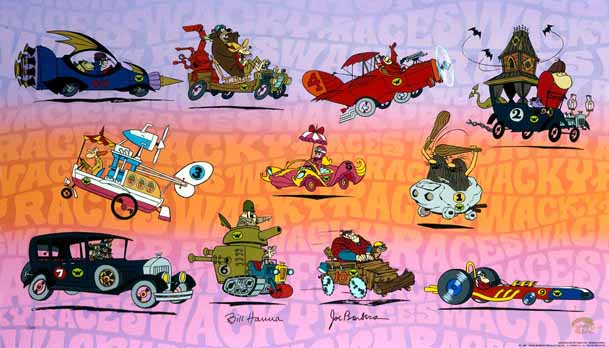
When Redline first came out, there were a lot of comparisons to Wacky Races floating around. If you haven’t seen Wacky Races before, do yourself a favor and go watch an episode now.

I loved Wacky Races when I was a kid. It was in the running with Roadrunner and Coyote for my favorite cartoon (you can probably see a theme here). So I was absolutely pumped for Redline‘s release. Unfortunately, all the hype left me a bit disappointed.

Wacky Races is… well… wacky. In the short segment I linked to, we have stop lights delivered by rockets, lassos, vehicles floating on top of geysers, and cars driven by bears, the mafia, and southern belles. Redline isn’t wacky in the silly way that Wacky Races is. A better word would be crazy— they bring things such as speed and danger beyond the point of ridiculousness. But the film never descends ascends into silliness and wackery. The only point of commonality between the two shows is a no-holds barred race. What is Wacky Races without being funny? It isn’t Wacky Races, that’s for sure. In its essence, Redline is not a film about a wacky race, but a drop of distilled manliness in its purest form.

Problematic comparisons aside, Redline is a fun movie. If you’re looking for an adrenaline-filled action flick, Redline‘s got pretty much everything you could ask for: absurd speeds, manly shouts, guns, girls, eternal friendship, betrayal, explosions, deranged robots, orbital bombardment, and battles between giant space monsters. The race takes place in the middle of a war zone. The film is certainly wild, if not wacky. In the end, the guy gets the girl, and our heroes win the race by literally a hair’s breath, running across the finish line at mach speed while their car explodes in the background.

The visuals are downright spectacular.  But the actual story and characters are decidedly less so. Much of the narrative comes across as an excuse to create explosions (not to imply that there is anything wrong with explosions!).

A few of the characters are mildly interesting, and I did enjoy seeing the relationship between JP, the mechanic and the junk dealer unfold. The spider mechanic coming to the junk dealer’s rescue was my favorite scene. I thought he was either going to defuse the bomb or shoot the junk dealer, not rescue him.

Sonoshee was the film’s weakest link, from my perspective. She began as a strong and independent woman, but ended up as JP’s long lost childhood friend, winning the race while sitting in his lap. Kind of sad. As for the rest of the racers… well, suffice to say that I couldn’t name a single one.

Redline’s an enjoyable watch, but it’s just not my thing. If you love action shows, though, be sure to give this a spin.

  • Plot / Script – 8 / 10 – Action-packed with lots of explosions. Don’t watch this for the story.
  • Characters – 8 / 10 – The lead and his two friends are interesting to watch, but the rest of the racers are neglected.
  • Production – 10 / 10 – In the running for one of the best animated shows I’ve seen. Madhouse spent a lot of time on this, and it shows.
  • Overall – B

Recommendations – Dead Leaves, Wacky Races

Since I’m late to the party on watching this, I have the opportunity to share a few interesting takes on the movie by people with better taste other bloggers.

  • Yi examines oral sex and lips in Redline
  • Animekritik discusses the names, robot writing system and Leijiverse tie-ins
  • E Minor explains how the narrative fell short
  • Ogue Maniax looks at fanservice and the “man of action” in Redline
  • inushinde found Redline a ton of fun, but not a classic
  • ghostlightning explains how badass Redline is
  • Mr. A thought Redline was “visually splendid” but lacking story-wise
  • psgels found Redline a “visual orgasm”, albeit not the best movie ever

Mawaru Penguindrum 08 — WTF?! One Crazy Bitch

Shouma, this is definitely not going to turn out well. Every warning siren in your brain should be screaming right now.

As expected.

Good Lord. Last week’s naked frog magicks were crazy enough, but disguising yourself as Yuri to rape him…

Shouma saves the day (well, sort of). Shouma says it all:

Shouma and Ringo’s Relationship

Their relationship has really been one of the highlights of the show for me. I’ve never seen a relationship quite like this one in anime. The two of them despise each other on the surface, but you can catch hints of the fact that they actually value one another.

On Shouma’s end you see this from the fact that he sticks with Ringo even though, as Kanba says, it would be much easier to simply steal the diary. Theft would probably also be less criminal and morally reprehensible than actually helping in her schemes. He shows a concern for Ringo beyond what simply recovering the diary demands. Not to mention his jumping in front of the car.

On Ringo’s side, it seems that she was actually hurt when Shouma called her the craziest bitch he’s ever met, as she hesitated and recalled his words when she was about to pick up the diary. She also seems to be objecting less and less to Shouma’s presence.

The thing that makes their relationship so interesting is that they actually do have mixed feelings, it’s not simply that they’re hiding their “true” feelings. Ringo is definitely not your typical tsundere, and neither of them fit at all into the molds we usually see.

A Few Quotes

When Ringo leaves the apartment, Shouma says “Breaking up is tough.” I liked this line simply because it could be interpreted in so many different ways.

  1. The obvious interpretation: he was referring to Ringo and Tabuki. Except they were never together in the first place.
  2. Referring to Shouma and Ringo. He said it as she was walking out on him.
  3. Referring to Ringo’s family.
  4. Referring to Ringo and her sister.
  5. Referring to Shouma, Kanba and their sister.

Another interesting quote was in Ringo’s western delusion, when she confronted Yuri and took Tabuki down from the noose. She tells Yuri, while grasping the diary, “I have something you don’t! That’s destiny! As long as I have this, our fates can’t be changed!”

She’s right, but not in the way that she intended. Because she’s bound to following the directions in the book, her fate can’t be changed— she can’t find a lover of her own, she can’t forget her sister, and she can’t build a new family with her mother. Ringo’s commitment to some idea of “destiny” has left her powerless to change her own fate.

Use of Comedy

One of Mawaru Penguindrum’s greatest strengths continues to be how it fits comedy right into the flow of the story without detracting from the seriousness of everything. As a case in point, see everything the penguins do. There’s so much happening at once that it’s impossible to get bored.

As another example from this episode, we have Tabuki’s dummy, and Tabuki’s conversation with Kanba and Shouma in the classroom revealing where he was the previous night. Then we have Shouma’s speculations on Project Murder-Suicide. He wasn’t too far off the mark— that box was indeed bad news.

Finally, there are Ringo’s delusions. These keep getting wilder and wilder— we had a western today. They’re hilarious, but also give us a glimpse of Ringo’s mind. This week, I especially loved the dream in the aquarium, and how it blended together seamlessly with reality.

Speculations

  • It seems like Kanba is doing other work for the penguin hat, as he let it slip to Shouma that he’s also working hard.
  • Ringo bought her stuffed animals at the aquarium too. Coincidence?!! (probably)
  • Ringo seems to see problems underlying the surface of Shouma and Kanba playing family. I wonder what’s going on there? I assume it’s more than them simply not being home much.
  • I’m guessing Shouma getting hit by the car will make Ringo reconsider her destiny plan. Is Shouma dead? I doubt it, but I could see it going well either way.
  • Why did the person on the motorcyle rip up the diary? No idea on this one.
Let’s see if this show can get any crazier. I have high hopes.

Liked this post? Subscribe to our RSS feed and follow us on Twitter!

No. 6 09 — Let’s Kill Grandma and Some Babies

This is more or less exactly how not to make me hate the bad guys.

Cheap Shots at No. 6

So the show No. 6 forgot about the city No. 6 since the first episode, and the creators seemed to just realize this. I can imagine how the conversation at the studio went.

“Hey, why is No. 6 evil again?”
“They killed the Indians.”
“Yeah, but everyone does that. That’s not too bad.”
“They tried to murder Shion!”
“Well, he was infected with a highly contagious disease. It’s disease control.”
“Hmm, you’re right… I know, let’s make them kill some babies!”
“Great idea! Let’s level a town and kill some old people too!”

This whole episode just screamed of laziness in developing the villains. This is made all the worse because there isn’t even a single face associated with the bad guys. As Mitt Romney would say, governments are people too.

Let’s examine the sins of No. 6 from this episode.

  1. They trick a cute little girl with their propaganda by giving her a balloon.
  2. They level an entire city and indiscriminately kill people with laser tanks.
  3. They kill the manager, who did all of… nothing… in the entire show.
  4. They try to kill a little baby.
  5. The Twilight Home turns out to be an execution chamber. (man, this was obvious)
  6. They dump people down garbage chutes.

No. 6 had the potential to comment on the dangers of totalitarian governments. But this isn’t the problem from the show’s perspective. Totalitarian governments are fine. Surveillance states are great. Second-class citizenship is A-OK. Shion and Nezumi need to overthrow the government because it kills babies, tricks little girls and has evil scientists modifying Safu. They’re simply appealing to the basest emotions pulling strings to elicit pity now. 1984 this is not. Instead of hating the government I’m laughing at how ridiculous it is and at the fact that not a single person in the show opposes it for rational reasons in the first place. Which brings us to…

The Opposition is More Evil

Nezumi also doesn’t particularly care about how No. 6 treats its citizens or the people on the outside. He wants to destroy No. 6 for revenge, since they killed the Indians. He doesn’t want to liberate it from an evil government, he wants to burn it to the ground and loot the place. Shion wants to stop people from dying from the bee disease, but seems perfectly content living in poverty and with people going to the correctional facility as long as he doesn’t know them. Everyone else outside No. 6 just assumes they’re powerless.

The situation inside No. 6 is even more dire. The reporter guy who’s hitting on Karan wants to overthrow No.6, but he’s evil, because… well… he has an evil laugh. He’s exactly like the creators of No. 6! It’s much better to sit around and do nothing than to start a revolution, because, well, we might get our hands dirty! Karan is the most morally bankrupt character in the entire show, and yet the creators seem to be taking her side. Why…?

None of the characters have any vision beyond burning No. 6 to the ground and looting it. The one character who may have such a vision is himself villainized for wishing to fight against No. 6. The message I’m getting from this show is that the best thing to do is submit to tyranny like Shion and his mother do.

Final Thoughts

  • I liked the scene where Nezumi let Dogkeeper be licked, I wasn’t expecting her to be so upset. I always love a good dissin’, and Dogkeeper delivered here. Oh, and it seems confirmed that Dogkeeper is actually a guy.
  • Why did the laser tanks stop their massacre of civilians when Nezumi raised his hands up? If only the rest of the town had thought of that…
  • Where did the reporter’s comrades come from?
  • Long insert song! Whoo hoo! Not.
  • The correctional institute is in the middle of nowhere, how exactly is making it fall supposed to destroy No. 6…?

I seem to be in the minority here (well, among the non-homophobes at least), but I really don’t get it: why do so many people seem to like this show so much? Everything I read talks about how there’s some great relationship between Shion and Nezumi and brilliant dialogue, but I don’t see it at all. Shion and Nezumi annoy me even more together than they do alone, and the lines in the script seem like they’re taken out of a bad play. Someone told me that the bad play vibes are part of the charm, but I just can’t see the appeal.

Liked this post? Subscribe to our RSS feed and follow us on Twitter!