So much was revealed this episode, but the mysteries still keep piling up.
The Destination of Fate
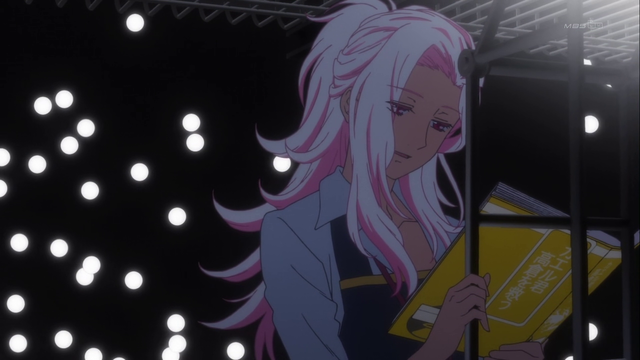
We begin with a monologue from Sanetoshi (the librarian) about how he hates the word fate. This may remind us of Shouma and Ringo’s monologues in the first episodes. In fact, they aren’t just similar: it is the exact same speech as Shouma’s! How are these two tied together?
The main difference between the two monologues stems from the visuals. When Shouma speaks, we are in a star-filled room with a sleeping Himari. During Sanetoshi’s spiel, the scene is quite similar: we are still looking at a sleeping Himari. But the stars are gone, and Himari is dead. Shouma, although he despises fate, has not lost his sense of wonder and joy as Sanetoshi has.
As for the content of the speech, Sanetoshi is from the Destination of Fate. And he hates the word fate? This is the last person we’d expect to hear this from! At the moment, I don’t think we have enough information to know why yet.

Sanetoshi also appears to know Shouma and Kanba’s father from the past: he puts the photo of the 36th Antarctic Environmental Defense team on the doctor’s table. The father appears to be the team’s leader. The scene is filled with penguins, and one of the penguin logos is quite conspicuous. This is an expedition to defend the environment: we could also call it a “survival strategy.”
Meet the Parents
As others have speculated, the Takakura parents were the masterminds behind the sarin gas attacks. The father seems definitively involved, as we see him entering the Kasumigaseki station, one of the stops where the attack took place. But I doubt that this is the end of the story.

First, note that the father initiates the plan upon hearing of Shouma and Kanba’s successful birth. It is a “survival strategy” not for himself, but for his children. As he walks into the station, the father says that what he is doing will bring peace.
Which brings us back to the penguin corporation and the mission to the Antarctic. How are these things related? I don’t know, and I doubt we have enough information to figure it out yet. But let’s consider the idea that their father did what he did to ensure the survival of the planet and his children.
This segment also fits in quite nicely with Super Frog Saves Tokyo, the book that Himari was searching for in the library. Frog and his friend battle the Worm underground to save the world. No one knows what they have done, and they are despised and scorned. But the fact that one person is cheering for him is enough for frog to keep courage. Similarly, Takakura descends underground to battle forces of evil. His actions are despised and not understood. But Shouma and Kanba are waiting for him, and this is enough.
A Sister’s Innocence and a Brother’s Love

Himari is appearing less and less innocent as the show continues. Now we have her joking about private parts, and delivering line after line of sexual innuendo as her penguin is stripped by and does some bondage play with Kanba’s penguin. Is she acting differently because Sho isn’t there and she is alone with Kanba? Her two personalities seem to be merging closer and closer together.

I’m still leaning towards the idea that the sister Himari and the penguin hat Himari are two facets of the same person, but either way, which person is Kanba in love with? There is more going on between Kanba and the penguin hat than we knew: Kanba knowingly gave her a portion of his life to extend Himari’s. Obviously, he loves his sister, but his more erotic affections seem to be reserved for the alien Himari (e.g., this episode’s stripping). Which girl did Kanba steal a kiss from?

The Myth of Mary
What are we to make of Shouma’s myth of Mary and the three little lambs? It bears some resemblance to the stories of Prometheus and the garden of Eden (and countless other myths).

Mary loves the three little lambs, and can’t wait to spin their wool into thread. Where have we seen thread imagery before? The red string of fate (note that the swirl on the lamb’s bellies is also red). Does Mary want to fix the Takakura sibling’s destinies?
Then we come to the apple tree in the garden, the first tree in the world. It has withered, but its light was once the source of the world’s love, future and dreams. We could see this as akin to the Tree of Knowledge in a gnostic interpretation of the creation story. For those unfamiliar with this version, a (very) short summary: the roles are inverted, and the god walking in the garden is a false god. He keeps the the knowledge of the true god (hidden in the fruit of the tree) from humans, but the true god comes in the form of the snake and gives knowledge to mankind.
Next, the black bunnies appear and tell Mary to fetch the ashes from the torch in the Goddess’ shrine and use them to revive the tree. But contact with the Goddess’ torch is forbidden. The black bunnies play the role of the snake, luring Mary to break the taboo.
The rabbits convince Mary and she takes the ashes. Mary, as Prometheus, steals the fire which the gods have hoarded and gives it to mankind. Alternatively, Adam and Eve see the light and their eyes are opened.
But the Goddess is furious, and takes the smallest lamb’s life as punishment. Prometheus is chained to a rock, and his liver is pecked out by an eagle every day. Adam and Eve are exiled (by the false god).

We’ve established the connection to the myth of Prometheus and the gnostic creation myth. But how does Mary’s story fit into Mawaru Penguindrum?
It appears that the souls of the sheep (the Takakura siblings) are the flames of the Godess’ torch. By sacrificing themselves (as Kanba has done) the sheep can prolong the life of the apple tree.
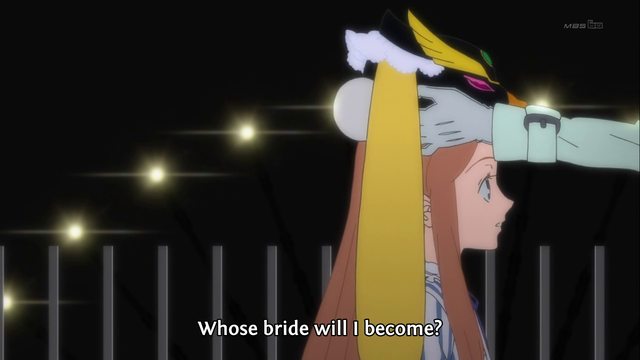
The next questions are the identites of Mary and the Goddess. It seems reasonable to guess that the Goddess is fate herself, who has afflicted Himari with a curse. Mary, although he bears a female name, is wearing a tie. Mary seems to hold much in common with Shouma and Kanba’s father. He has broken a taboo (executing the gas attacks) as part of a survival strategy for the apple tree. The apple tree in this context could be the Earth itself, if we consider the discussion from earlier.
One last question: what are the dark bunnies? A dark, uncontrollable force fighting against fate: they seem similar to the Worm from Super Frog Saves Tokyo. Why is Sanetoshi leading them?
Further Thoughts

- I wonder what animals the young Tabuki was supposed to take care of? Birds?

- What’s up with Tabuki’s fingers here? After the Sarin gas attacks, the perpetrators mailed a bomb to Yukio Aoshima, the governor of Tokyo, and blew the fingers off his secretary’s hand.
- When Tabuki refuses to believe that Momoka has died, we jump to a shot of a bird in a cage. Her death has trapped him in the past, unwilling to fly and move on.
- Great music in this episode, especially the piano piece towards the middle.
- The myth sequence was beautifully choreographed: the two storylines happening at the same time fit together perfectly.
- Penguin hat Himari claims that she is also from the destination of fate. I’m sticking with my theory that the destination of fate is death.

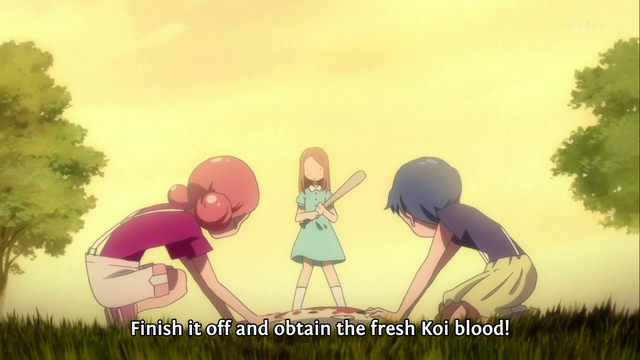
- D’aaaawwww. Baby Ringo is so cute. She’s always been attached to that diary.

- Sanetoshi’s apple has a different symbol than the yin-yang penguin head. What is it supposed to be? It kind of looks like a candle to me. The Godess’ torch?
- Who is the girl saying “Because punishment has to be the most unjust” at the end?
I look forward to hearing your own theories in the comments!
Note: I’ll be out of town this weekend, so Dantalian will be delayed. As will any first impressions posts for new series.

Liked this post? Subscribe to our RSS feed and follow us on Twitter!


 Wow, this may have been even stronger than the previous episode. The previous episode had a great sense of mystery, but this one had a sense of excitement and thrill that we haven’t seen so far.
 The first thing I noticed is that Kanba really does seem to love his brother (and sister). Ringo’s comment that Shouma’s family life was fake had left me wondering, but Kanba at least gives the appearance of being completely dedicated to his brother and sister. He stays all night worrying by Shouma’s bedside, even though he tries to hide it. One thing in this episode seems to jar with that image though: the actions of Kanba’s penguin. As we’ve seen, the penguin’s actions tend to reflect the thoughts and actions of their owners. And here, for most of the episode, Kanba’s penguin is busy stealing underwear, reading porn magazines, and looking up the nurses’ skirts. Perhaps all is not as it seems…
  Another hint to this effect is that Kanba does not want to give the diary back, instead entrusting it to Ringo. This is probably just his cool and collected self remaining in control, but let’s leave the possibilities open.
 Then we have Kanba’s conversation with Himari, which was hilarious. How dense can you be? But yeah, Kanba is a confirmed siscon now. Interestingly, Himari doesn’t seem quite so innocent towards the end of this scene, where she leans in close and pats Kanba on the head. Perhaps this is a glimpse of her true feelings, which are revealed through the penguin hat.
 Also, look at how what happens with Masako parallels Kanba’s conversation with Himari. Himari asks whether boys would like homemade lunches, cakes, or hand-knitted sweaters. Kanba says no, they don’t want any of that “made with love” crap, unless it’s from Himari. Then Himari leans in close, pats Kanba’s head and disappears. Masako presents the same items to Kanba: homemade bento, a wedding cake, and a hand-knitted sweater. He rejects all of them, except for the unfinished undersized sweater which he is forced to wear. Notice how Kanba tells Himari that girls always make oversized sweaters: the sweater must have been made long ago. When he arrives at his destination, Masako kisses him and disappears.
  On a side note, Masako’s disappearance scene was excellent: I really thought she was going to shoot Kanba, but instead she jumped eagerly into his arms. Perhaps her Project M has the same goal as Ringo’s after all. We could also interpret this sequence as Kanba’s fall from innocence: he initially chases Masako’s fleeting image through the fields of white sheets, to the sounds of the music box. Then the music box cracks, and things start to go wrong. He enters deeper and deeper into a relationship, while continuing to feel more and more trapped. He finally ends up in the torture chamber, where he is confronted with a kiss. By the way, does anyone know what music was playing during this sequence? It seems so familiar, like it’s on the tip of my tongue, but I just can’t quite warp my head around it.
 Himari and Mario are paired, as we saw in the previous episode with the Child Broiler. (also, notice the まり in both of their names) I am sure we will see exactly how they are different in the future. Kanba and Masako seem to take on similar roles in both sides of the conflict, as the people who do the dirty work. Kanba is most likely Masako’s “fated” person, but Kanba only has eyes for Himari. They’ve sure done a great job of making Masako seem dangerous, with that crazy slingshot, the dark penguin sharpening the knife, the blowtorches, torture rack and injections.
  Does Shouma have a counterpart on the other side? I am guessing yes— Tabuki. Note how when Ringo picked up her cellphone it gave a chirping noise, which previously rang for Tabuki. Ringo seems like the type of girl to set individual ringtones. And this also would put Shouma and Tabuki in opposition over Ringo. On that front, Shouma seems to be making some progress, as we witnessed Ringo’s guilt and appreciation for perhaps the first time. Plus, her diary is gone. Fate is now an open book.