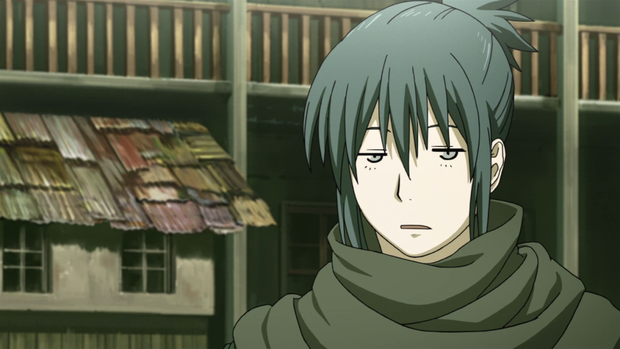
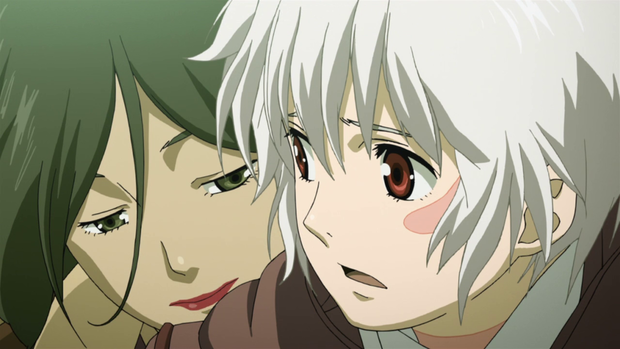
We have a visit to the Oracle, rescuing the forest folk… Is this a bad RPG adaptation now? And we still haven’t gotten inside No. 6 yet?
Engaging Storytelling
In this episode we follow Shion and Nezumi’s journey to the center of the earth. They are brought as prisoners to the great hall of Argatha, where they offer a prayer to the Oracle, surrounded by his ascetic sackcloth-clad followers watching from the balconies. The Oracle was one of the chief architects of No. 6, but was exiled after he discovered what the leadership was up to. He gives Shion a USB key with the results of his research on No. 6 and the parasite bees, of which he was the first victim.
So, let’s review what we learned this episode.
- No. 6 and the other cities were constructed very recently after all but six patches of land were destroyed in war. I thought it had been much longer.
- The killer bees are not exactly a new phenomenon.
- No. 6 eliminates all who come in contact with the bees. So the reason they tried to kill Shion was probably not because he was a dissenter.
- No. 6 has an evil evil plan. It would take too much time to explain. But it’s evil!
- Shion’s mother was involved in the construction of No. 6.
- Nezumi is the last of the Mohicans, who were destroyed by No. 6. This explains why he is so noble (and savage) and why he is one with nature (the king of the rats).
- The leader of the forest folk, Elyurias (I get the feeling it’s a tree or something), is calling out with its song to Nezumi and Safu.
These are probably the most interesting developments the story has had since episode two. So we’re starting to get somewhere. But I still took issue with the way everything was presented. The oracle asks Shion if he wants to know the truth. And then he just blathers everything to Shion. “Show, not tell” is the saying. And No. 6 just literally delivered an entire episode’s worth of exposition from the mouth of an oracle. An oracle who we didn’t even know existed until this episode. What a great way to tell a story, No. 6. You always manage to keep things exciting.

Overacting
The dialogue continues to feel fake to me. The characters are all highly articulate, complete with hand gestures and dramatic pauses. It’s like they’re acting out a play.
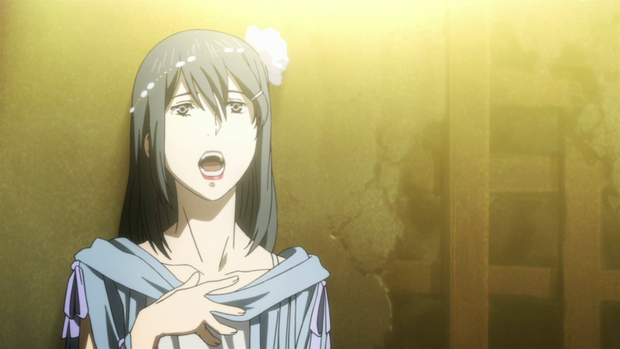
As one example, take Nezumi’s insert song. He comes out singing with a beautiful voice, with perfect posture, arms taut at his side. The cavemen scream in pain in the background (why are they afraid of the song…?). A lighting crew and an orchestra join in to accompany him. Then, for no apparent reason, Nezumi dramatically collapses, as Shion catches him. Ok… why?
For a second example, take the scene where the Oracle says “Elyurias… that is her name.” Nezumi’s gasps and his eyes wobble in fear. Right. Such a scaaary name. Sounds like the name of an angel or something.
And then there’s this scene, where the Oracle tells Nezumi what will happen if he kills the people of No. 6:


How could he possibly not have realized this…? The characters reactions’ are so over the top that I have trouble taking them seriously.
Speculation
What does the future hold for No. 6? Not much, since there are only three episodes left. And for this show to come to a solid conclusion, they are going to need to pack more into those three episodes than they’ve put into the past six. Good luck with that.


 I think I may have finally been able to put my finger on what bothers me so much about this show: it’s the dialogue. It’s just too well thought out and over-dramatized. It doesn’t sound like the characters are having a conversation. It sounds like they’re reading out the lines from a play that they memorized. This has the effect of making the characters’ interaction feel superficial and downright corny. This comes out even more strongly in the BL scenes, when what’s going on is corny enough as it is. The character that suffers least from this is the dog woman: her spontaneity rescues her from an impression of superficiality, even if some of her lines are a bit too in-your-face philosophical. No. 6 tries to be intelligent by having the characters quote Shakespeare and Oscar Wilde, and argue about philosophy: this makes it come across as pretentious. Compare No. approach to Mawaru Penguindrum, which involves stalkers, delusions, penguins, magical hats and slapstick comedy. Which of the two shows is more intelligent and witty?