The last few episodes have been incredible in terms of mindfuckery and fueling speculation. This episode took a step back, slowed down, and built up a tense and melancholic atmosphere to let the viewers absorb the enormity of the Takakura parents’ actions.
Dual Survival Strategies
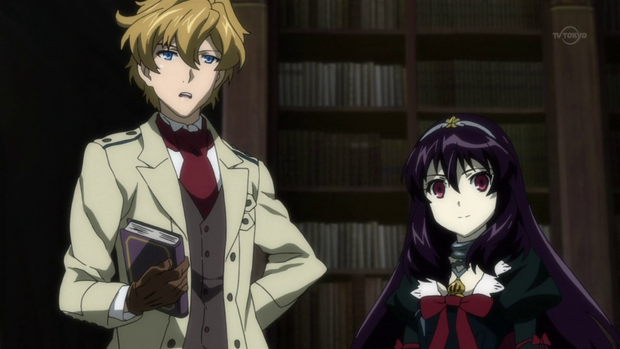
Sixteen years ago, Sanetoshi met a pink-haired girl who could hear the world crying out to be saved just as he could. But she would not agree to do things the way he wanted to. Based on the timing and the fact that it was a child, I am guessing this girl is Momoka. Furthermore, based on the way the camera lingers on the hat, we can suppose that she is also the penguin hat. Furthermore, we learned that Sanetoshi is saving Mario for Masako. I mentioned how the light and the dark penguins are duals a few weeks ago, but now we can take this a bit further since we know who their leaders are.
First, let’s look at Sanetoshi and his counterpart’s commonalities.


Hm, this seems familiar.


They’re both full of themselves.


There is always a price.


Here is the key difference. Sanetoshi provides a drug to save Himari. He is the one with the power, as he so ardently proclaims. But the girl with the penguin hat tells Shouma and Kanba how to save Himari themselves. This is why the penguin hat, as we learned in the last episode, does not want the penguin drum to fall into Sanetoshi’s hands. Sanetoshi wishes to control fate himself, as we see from his “experiments”. But the penguin hat believes people should control their own fates. This is why the girl in the library would not follow Sanetoshi.
Along the same lines, both the penguin hat and Sanetoshi have mentioned the Scorpion’s heart while referring to Kanba. AJthefourth explains how this is a reference to Night on the Galactic Railroad:
Scorpio was caught by a weasel and was about to be eaten. Scorpio tries to get away, falls into a well, and just as he is about to die begins to pray. He thinks back on the creatures he had eaten and killed in his lifetime, and wishes that, upon his death, he would at least be eaten by the weasel so that the weasel would live another day, instead of his dying in vain in a well. He tells God to look inside his heart and ensure that in his next life, his body will be used for good and happiness. He then turns bright red and becomes a flame that lights up the darkness of the sky.
The penguin hat sees the scorpion’s heart (a.k.a., Kanba’s) as beautiful. But to Sanetoshi, it is hideous and charred.
The Fickle Goddess
The Goddess came across as even crueler in this episode than before. She decides to spare the third lamb, because “it would be no fun if the punishment ended here.” But perhaps the most disturbing part is that the rabbits, which originally led Mary into taking the ashes of the torch, agree with the Goddess. The rabbits were creatures of the Goddess all along; they were “called forth by the world” itself.

Continuing with our discussion of Gnostic myth from last week, we have the unwitting snake / rabbits, which the spirit of the Logos departed from before the demiurge’s curse. And Sanetoshi is developing similarities to the demiurge himself: he believes himself to be the only one in the world, the creator of all that is, before he glimpses a shadow of the pleroma (the girl’s footsteps). But the light will not return to him, and in his anger he seeks to recreate the image he has seen (in Sanetoshi’s case, through drugs and controlling fate). Himari bears a resemblance to Sophia: she is both a saint and a prostitute, for one, and utterly unknowable.
I’m planning to elaborate more on all of this in a future post. For the record, I don’t think that Penguindrum is influenced directly by gnosticism. Rather, myth and anime are both products of the human imagination, and reveal the underlying structure of the human mind. So there should be no surprise that the stories are similar.
Music
I generally don’t pay much heed to the music in anime, but this episode did a fantastic job. I’ll point out two examples.
First, consider the scene where the police come to take the children away. A slow, subdued piano place plays in the background. But when Shouma opens the door, silence reigns. Silence is often the most effective music. Next, we hear a buzzing / ringing sound in the background, indicating that something is not right. As the cop steps into the house uninvited, a lower tone joins into the cacophony. The second officer steps past the threshold, and the phone begins to ring, joining in the mix. Kanba’s anger builds while he speaks with the officers, and Himari offers him the phone. “Stay in your room!” Kanba shouts. Himari jumps back, and all sound ceases. This segment was fraught with tension from the music.
Later, in the hospital, a subdued piano piece begins once again, and continues until the flashback in the hotel. The phone rings and silence returns. Their uncle tells them to turn on the TV, and a sneaky, plodding percussive piece begins, but slowly at first. This piece gives the viewer a gentle tingle of foreboding. It continues until the Takakura parents’ faces are shown on the television. Then, the same ringing noise from earlier makes its return, and builds into a crescendo. Ohhhhhhhh crap.

The beat changes slightly, and the song continues. Once Himari wakes up, the bells fall back and the brass enters in. Shouma continues the goddess’ story as this jazzy little tune carries on. The Goddess begins speaking her line, “It would be no fun if the punishment ended here.” The snare speeds up and plays a steady beat for a small crescendo. Then silence once again, while the Goddess continues speaking. As she finishes, the last two notes play, ending without closure, leaving us expecting a few more notes. “That’s right!” the rabbits supply. And we stop for a commercial break.
The music in these two segments and the way it was aligned with the animation and voice acting were exceptional, and allowed me to become fully engrossed in the story.
Further Thoughts
- After the attacks, they built a sky metro? Could this fit in with Masako’s talk on how light and darkness must coexist? The underground Hole in the Sky?
- I enjoyed how Sanetoshi broke the fourth wall.
- Ringo has moved on from trying to become Momoka, with some excellent advice from Tabuki. But I like how she still believes in fate, despite all that has happened.

Liked this post? Subscribe to our RSS feed and follow us on Twitter!