Category Archives: Reviews

Kore wa Zombie Desu Ka?! Review – B-

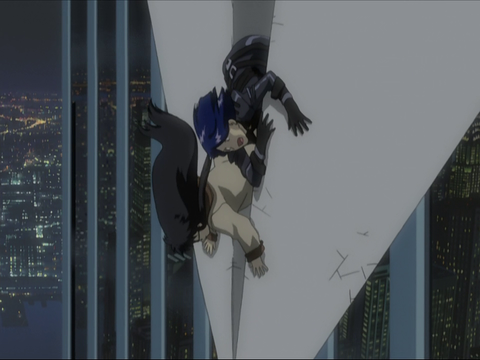
Kore wa Zombie Desu Ka?! follows the recently deceased Ayumu as he begins life as a zombie, living with Eu, the necromancer who revived him, Haruna, a magical girl, and Sera, a vampire ninja. Ayumu soon absorbs Haruna’s powers and becomes a magical girl himself. Our hero’s party battles fleets of flying whales, crazy women, giant stuffed animals and golems using the power of a magical girl’s chainsaw, leaves, and ramen.

I’ll be the first to admit that most of this show doesn’t make any sense whatsoever. But who cares? Making sense is boring. And Kore wa Zombie Desu Ka is certainly not boring. There were a few episodes in the middle where the show attempted to be serious and make sense (it actually didn’t do too bad, either) but fortunately the creators abandoned this endeavor and went back to the ridiculousness that made the show so much fun to watch in the first place.

One thing which I found that the show does particularly well at is combining the plot (such as it is) with comedy. Anime often have a tendency to focus only on comedy or only on the plot exclusively, and they’ll often end with a “climax” of sorts which is entirely serious and drains all the fun out of the show. Kore wa Zombie Desu Ka?! does an excellent job avoiding this: they even have the main antagonist tell a completely non-sensical joke and relive all the tension right at the peak of the climax.

The characters start out seeming annoying: Haruna has a cheerful, genius-level idiocy and refuses to wear pants; Sera is only capable of cussing; and Tomonori takes the role of the young “wife”. But all of them eventually grew on me as they played more of a role in the show. Harun’s genius became more idiotic, Sera’s disses improved from the initially generic insults to ones more specific to Ayumu and the situation, and Tomonori was sat on by a humongous stuffed animal and transformed into a golem.

Overall, I recommend giving this show a watch if you’re looking for some brainless humor.

  • Plot / Script – 8 / 10 – Not so much in the way of a plot, but consistent and fresh jokes.
  • Characters – 8 / 10 – Start out seeming annoying but quickly gain traction.
  • Production – 7 / 10 – About average in animation.
  • Overall – B-

Recommendations – Ichiban Ushiro no Daimao

Onii-chan no Koto nanka Zenzen Suki Janain Dakara ne!! Review — D

Onii-chan no Koto… shows the life of Shuusuke and his harem of three girls: his (adopted) sister Nao, his childhood friend and freakish stalker Iroha, and class president / closet BL-lover Kondou. The show got off to a strong start in the first few episodes, but managed to lose most of its momentum in the middle by repeating the same jokes over and over again. It was funny the first time Iroha spied on Shuusuke through her telescope and they formed a chain of five people stalking each other. It was less funny six episodes later when Nao and Iroha had done nothing the entire time except follow Shuusuke from the shadows.

The characters could have been interesting, and were when they were first introduced, but quickly lost steam when the creators had them do the same jokes over and over. Nao especially is a fun character to watch as she plots ways to seduce her unwitting brother and loves him for how disgusting and pathetic he is: but in the second half of the series she was basically relegated to a background stalker. Nao’s two friends make an excellent counterweight to her obsessiveness, but they disappeared about halfway through the series. Iroha was amusing for the first episode… but again, after ten episodes of doing nothing but stalking, it can get a bit stale. Her unexplained unholy alliance with Nao throughout the middle of the series didn’t help, as one of the more amusing aspects of her character was giving Nao someone to fight with. Kondou was entertaining when she was having Shuusuke buy her BL books, but after she discovered Shuusuke’s nipples the creators pushed her into the background as well. So all in all, the characters were interesting but poorly utilized.

  • Plot / Script – 3 / 10 – Most of the jokes are used up in the first episode. Six episodes of Nao and Iroha stalking Shuusuke from the shadows are not funny.
  • Characters – 7 / 10 – The characters themselves have potential to be entertaining (particularly Nao and Shuusuke, when he actually does something) but they’re used poorly.
  • Production – 8 / 10 – The animation is definitely unique and enjoyable, particularly the distorted faces. The music and voice acting was not so great.
  • Overall – D

Recommendations – Ore no Imouto…, B Gata H Kei

Dragon Crisis Review – F

I’ll admit, from the minute in the first episode when a girl came out of a suitcase who could do nothing but say the main character’s name and hug him, my expectations were very low. And they weren’t disappointed.

The biggest problem is that the characters are completely one-dimensional and boring. Case in point: Rose, the aforementioned suitcase girl who is actually a dragon (the main difference between dragons and humans is that dragons go into heat frequently). She quite literally does nothing the entire show except obsess over the main character, Ryuuji, and act cute. Cute as in act like an annoying three-year old cute, except somehow she’s in middle school. Ryuuji is even more annoying: the generic harem lead, his only role is to be indecisive enough so that a hoard of pubescent girls can fight over him without his notice. Then there is Eriko, Ryuuji’s cousin… all I can really say about her after twelve episodes is that she shoots butterflies, used to live in America, and has breasts.

The supporting characters are a bit less annoying (probably because they showed up less). There’s a stereotypical mad scientist, complete with lab coat and spectacles; another mad scientist, who is also a pyromaniac; a European young lady, complete with parasol; the girl in class with a crush on the main character who is to shy to tell him; the girl of tragedy who underwent human experimentation to become a fox girl; the tomboy; the evil black dragon who *gasp* wants to build his own harem, and the priest who struggles over his duty. The priest was the most interesting character, so of course he didn’t show up after episode four. Each haremette starred in a couple episodes and otherwise didn’t have much of a role in the show.

The show seemed to have an interesting setting, but didn’t do much of anything with it except make BS up as it went along. The series seemed to get worse over a time, with the last episode almost reaching the point of so awful it was funny. The climax of the show comes when Ryuuji and Rose upgrade their power to “love engage” by kissing on the mouth instead of the hand, and the enemy is defeated by a pink heart. Seriously.

  • Plot / Script – 4 / 10 – Gaping plot holes… like in one day Rose goes from saying one word to complete sentences and no one notices. The main sources of tension are going into heat and ten minute bursts of amnesia.
  • Characters – 3 / 10 – Cliched and annoying (esp. the main characters)
  • Production – 7 / 10 – Nothing special, but not bad either. The music is ok.
  • Overall – F – Don’t watch it unless you’re really bored.

Recommendations – any of JC Staff’s other shows with the same premise (this is one of the worst) – Shakugan no Shana, Zero no Tsukaima, Yumekui Merry, etc.

Asatte no Houko Review – B+

Summary: Karada lives alone with her brother Hiro after her parents die, and wishes that she were an adult so that she could help her brother more. Shouko, Hiro’s girlfriend from when he lived abroad in America, comes to their town and meets Hiro again, who abandoned her to take care of Karada. By the power of an ancient shrine, Karada and Shouko’s wishes are granted as they switch ages. They are forced to deal with the consequences and learn to accept themselves as they search for a way to return to their original form.

Discussion: I had been hearing good things about a Asatte no Houko for a while, but had kept putting it off because of its premise. Swapping ages does not exactly sound promising, particularly when my mind somehow associates it with the gender-swap genre. Asatte no Houko’s premise is ridiculous but the execution is excellent and more than makes up for it.

First of all, the characters are fantastic, particularly for Shouko and Karada, the female leads.  The viewer is able to see why Shouko and Karada do the things they do, which differ drastically between the two  – there are no big surprises here since the viewer is really able to understand the characters. This enables the drama to come through and turns this show into quite the tearjerker. The pacing was excellent as well. I’ll often find myself losing interest in dramas like this and end up fast-forwarding, but I felt no urge to do so here.


The way the creators used the premise of swapping ages was masterfully done in spite of how ridiculous it seems. As one would expect, there were plenty of jokes about the age swap- Shouko trying to smoke cigarettes and picking fights with adults and teenagers who treat her like a kid, and Karada trying to get a job. But despite the humor surrounding the situation, the creators are able to turn it into a serious, heartwarming drama as well. I should also mention that little girl Shouko is extremely cute.

Overall, Asatte no Houko was excellent, but there was one thing which annoyed me a lot- Hiro, Shouko’s ex-girlfriend and Karada’s brother. Most of the cast was very well-developed— except for him, and he is central to the entire plot. For most of the show he didn’t even have eyes which was extremely creepy. They had me convinced he was going to end up raping someone (spoiler: he doesn’t). I assume the creators were going for the “now he’s transformed and his eyes are open” angle, but I wish they could have found a more subtle way to do so. He also has about the initiative of a doorknob, although he does improve somewhat by the end of the show.

My only other complaint is that there were too many deus ex machina in the plot. People conveniently running into each other is one thing, but Karada just happening to run away from home to the bed and breakfast her friends would be staying at was just too much. Still, a relatively minor problem which is easily overlooked as part of the whole.

  • Plot / Script –  9 / 10 – Excellent pacing, dialogue and humor.
  • Characters – 9 / 10 – Great development of the cast excluding Hiro.
  • Production –  9 / 10 – The artwork is good but not too special, and fits well with the story. But the background piano music is exceptional.
  • Overall – B+

Recommendations – Kashimashi (good), Myself; Yourself, H20 (these two aren’t really that good, but have a similar feel)

Hi no Tori – Review A-

I finally finished Phoenix today after starting it approximately one year ago. This isn’t due to any fault of the show but due to my poor watching habits – I’ll start watching something and then either forget about it or not want to finish it because I like it and if I watch it it’ll be over. I still have about five episodes left of Utena which I started two years ago, and two episodes left of Lucky Star which I began three years ago. And in that interval I watched the first ten episodes of Lucky Star at least three times… But fortunately I remembered Hi no Tori yesterday and it hasn’t suffered the same fate. One of the advantages of having nothing new to watch on Tuesdays and Wednesdays.

Hi no Tori is a collection of short stories, each one to four episodes long, which involve the titular Phoenix to some degree.  It’s based on the manga which is widely considered to be Osamu Tezuka’s masterwork, which unfortunately I haven’t read. Initially all the stories seem completely disparate, but the way the creators bring the stories together in the end really stands out. I’m generally wary of shows which depend on separate plot arcs (especially episodic shows), but Hi no Tori did an excellent job at telling the shorter stories in the span of a few episodes without feeling rushed at all. In the last two arc, they managed to compress several billion years into two episodes and make it feel like a really long time, so the creators were definitely doing something right on this front. Making the best use of the time a show has is really a challenge which so many shows screw up on, but Hi no Tori manages to do just right. In just thirteen episodes it manages to have a larger, more developed cast than most two-season shows with at least double the plot content.

The other character that all the stories have in common besides the Phoenix is Saruta, who plays a different role every time. He’s never the main character of the arc but always a side character. I thought this was kind of strange, until at the end all the pieces came together and it became clear why this was so. Many of the characters are cursed with immortality and long lives. Saruta never is, but he lives as long as any of them in a sense. And the true driving force of the narrative in each arc is not the main character of that arc; it is the Phoenix throughout the entire story.

  • Plot / Script – 10 / 10 – Very compelling stories in all of the arcs.
  • Characters – 9 / 10 – Suffered a bit from their short shelf life.
  • Production – 9 / 10 – Pleasant visuals, although I’ve noticed that none of the hands are very lifelike…
  • Overall – A-

Recommendations – sola, Simoun (can’t say I’ve seen anything quite like Hi no Tori)