Redline Review — B

When Redline first came out, there were a lot of comparisons to Wacky Races floating around. If you haven’t seen Wacky Races before, do yourself a favor and go watch an episode now.
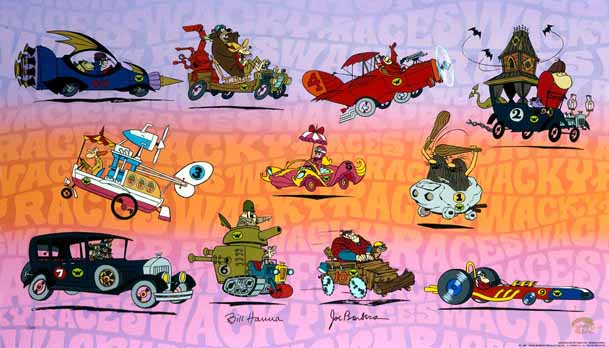
I loved Wacky Races when I was a kid. It was in the running with Roadrunner and Coyote for my favorite cartoon (you can probably see a theme here). So I was absolutely pumped for Redline‘s release. Unfortunately, all the hype left me a bit disappointed.

Wacky Races is… well… wacky. In the short segment I linked to, we have stop lights delivered by rockets, lassos, vehicles floating on top of geysers, and cars driven by bears, the mafia, and southern belles. Redline isn’t wacky in the silly way that Wacky Races is. A better word would be crazy— they bring things such as speed and danger beyond the point of ridiculousness. But the film never descends ascends into silliness and wackery. The only point of commonality between the two shows is a no-holds barred race. What is Wacky Races without being funny? It isn’t Wacky Races, that’s for sure. In its essence, Redline is not a film about a wacky race, but a drop of distilled manliness in its purest form.

Problematic comparisons aside, Redline is a fun movie. If you’re looking for an adrenaline-filled action flick, Redline‘s got pretty much everything you could ask for: absurd speeds, manly shouts, guns, girls, eternal friendship, betrayal, explosions, deranged robots, orbital bombardment, and battles between giant space monsters. The race takes place in the middle of a war zone. The film is certainly wild, if not wacky. In the end, the guy gets the girl, and our heroes win the race by literally a hair’s breath, running across the finish line at mach speed while their car explodes in the background.

The visuals are downright spectacular.  But the actual story and characters are decidedly less so. Much of the narrative comes across as an excuse to create explosions (not to imply that there is anything wrong with explosions!).

A few of the characters are mildly interesting, and I did enjoy seeing the relationship between JP, the mechanic and the junk dealer unfold. The spider mechanic coming to the junk dealer’s rescue was my favorite scene. I thought he was either going to defuse the bomb or shoot the junk dealer, not rescue him.

Sonoshee was the film’s weakest link, from my perspective. She began as a strong and independent woman, but ended up as JP’s long lost childhood friend, winning the race while sitting in his lap. Kind of sad. As for the rest of the racers… well, suffice to say that I couldn’t name a single one.

Redline’s an enjoyable watch, but it’s just not my thing. If you love action shows, though, be sure to give this a spin.

  • Plot / Script – 8 / 10 – Action-packed with lots of explosions. Don’t watch this for the story.
  • Characters – 8 / 10 – The lead and his two friends are interesting to watch, but the rest of the racers are neglected.
  • Production – 10 / 10 – In the running for one of the best animated shows I’ve seen. Madhouse spent a lot of time on this, and it shows.
  • Overall – B

Recommendations – Dead Leaves, Wacky Races

Since I’m late to the party on watching this, I have the opportunity to share a few interesting takes on the movie by people with better taste other bloggers.

  • Yi examines oral sex and lips in Redline
  • Animekritik discusses the names, robot writing system and Leijiverse tie-ins
  • E Minor explains how the narrative fell short
  • Ogue Maniax looks at fanservice and the “man of action” in Redline
  • inushinde found Redline a ton of fun, but not a classic
  • ghostlightning explains how badass Redline is
  • Mr. A thought Redline was “visually splendid” but lacking story-wise
  • psgels found Redline a “visual orgasm”, albeit not the best movie ever

Mawaru Penguindrum 08 — WTF?! One Crazy Bitch

Shouma, this is definitely not going to turn out well. Every warning siren in your brain should be screaming right now.

As expected.

Good Lord. Last week’s naked frog magicks were crazy enough, but disguising yourself as Yuri to rape him…

Shouma saves the day (well, sort of). Shouma says it all:

Shouma and Ringo’s Relationship

Their relationship has really been one of the highlights of the show for me. I’ve never seen a relationship quite like this one in anime. The two of them despise each other on the surface, but you can catch hints of the fact that they actually value one another.

On Shouma’s end you see this from the fact that he sticks with Ringo even though, as Kanba says, it would be much easier to simply steal the diary. Theft would probably also be less criminal and morally reprehensible than actually helping in her schemes. He shows a concern for Ringo beyond what simply recovering the diary demands. Not to mention his jumping in front of the car.

On Ringo’s side, it seems that she was actually hurt when Shouma called her the craziest bitch he’s ever met, as she hesitated and recalled his words when she was about to pick up the diary. She also seems to be objecting less and less to Shouma’s presence.

The thing that makes their relationship so interesting is that they actually do have mixed feelings, it’s not simply that they’re hiding their “true” feelings. Ringo is definitely not your typical tsundere, and neither of them fit at all into the molds we usually see.

A Few Quotes

When Ringo leaves the apartment, Shouma says “Breaking up is tough.” I liked this line simply because it could be interpreted in so many different ways.

  1. The obvious interpretation: he was referring to Ringo and Tabuki. Except they were never together in the first place.
  2. Referring to Shouma and Ringo. He said it as she was walking out on him.
  3. Referring to Ringo’s family.
  4. Referring to Ringo and her sister.
  5. Referring to Shouma, Kanba and their sister.

Another interesting quote was in Ringo’s western delusion, when she confronted Yuri and took Tabuki down from the noose. She tells Yuri, while grasping the diary, “I have something you don’t! That’s destiny! As long as I have this, our fates can’t be changed!”

She’s right, but not in the way that she intended. Because she’s bound to following the directions in the book, her fate can’t be changed— she can’t find a lover of her own, she can’t forget her sister, and she can’t build a new family with her mother. Ringo’s commitment to some idea of “destiny” has left her powerless to change her own fate.

Use of Comedy

One of Mawaru Penguindrum’s greatest strengths continues to be how it fits comedy right into the flow of the story without detracting from the seriousness of everything. As a case in point, see everything the penguins do. There’s so much happening at once that it’s impossible to get bored.

As another example from this episode, we have Tabuki’s dummy, and Tabuki’s conversation with Kanba and Shouma in the classroom revealing where he was the previous night. Then we have Shouma’s speculations on Project Murder-Suicide. He wasn’t too far off the mark— that box was indeed bad news.

Finally, there are Ringo’s delusions. These keep getting wilder and wilder— we had a western today. They’re hilarious, but also give us a glimpse of Ringo’s mind. This week, I especially loved the dream in the aquarium, and how it blended together seamlessly with reality.

Speculations

  • It seems like Kanba is doing other work for the penguin hat, as he let it slip to Shouma that he’s also working hard.
  • Ringo bought her stuffed animals at the aquarium too. Coincidence?!! (probably)
  • Ringo seems to see problems underlying the surface of Shouma and Kanba playing family. I wonder what’s going on there? I assume it’s more than them simply not being home much.
  • I’m guessing Shouma getting hit by the car will make Ringo reconsider her destiny plan. Is Shouma dead? I doubt it, but I could see it going well either way.
  • Why did the person on the motorcyle rip up the diary? No idea on this one.
Let’s see if this show can get any crazier. I have high hopes.

Liked this post? Subscribe to our RSS feed and follow us on Twitter!

No. 6 09 — Let’s Kill Grandma and Some Babies

This is more or less exactly how not to make me hate the bad guys.

Cheap Shots at No. 6

So the show No. 6 forgot about the city No. 6 since the first episode, and the creators seemed to just realize this. I can imagine how the conversation at the studio went.

“Hey, why is No. 6 evil again?”
“They killed the Indians.”
“Yeah, but everyone does that. That’s not too bad.”
“They tried to murder Shion!”
“Well, he was infected with a highly contagious disease. It’s disease control.”
“Hmm, you’re right… I know, let’s make them kill some babies!”
“Great idea! Let’s level a town and kill some old people too!”

This whole episode just screamed of laziness in developing the villains. This is made all the worse because there isn’t even a single face associated with the bad guys. As Mitt Romney would say, governments are people too.

Let’s examine the sins of No. 6 from this episode.

  1. They trick a cute little girl with their propaganda by giving her a balloon.
  2. They level an entire city and indiscriminately kill people with laser tanks.
  3. They kill the manager, who did all of… nothing… in the entire show.
  4. They try to kill a little baby.
  5. The Twilight Home turns out to be an execution chamber. (man, this was obvious)
  6. They dump people down garbage chutes.

No. 6 had the potential to comment on the dangers of totalitarian governments. But this isn’t the problem from the show’s perspective. Totalitarian governments are fine. Surveillance states are great. Second-class citizenship is A-OK. Shion and Nezumi need to overthrow the government because it kills babies, tricks little girls and has evil scientists modifying Safu. They’re simply appealing to the basest emotions pulling strings to elicit pity now. 1984 this is not. Instead of hating the government I’m laughing at how ridiculous it is and at the fact that not a single person in the show opposes it for rational reasons in the first place. Which brings us to…

The Opposition is More Evil

Nezumi also doesn’t particularly care about how No. 6 treats its citizens or the people on the outside. He wants to destroy No. 6 for revenge, since they killed the Indians. He doesn’t want to liberate it from an evil government, he wants to burn it to the ground and loot the place. Shion wants to stop people from dying from the bee disease, but seems perfectly content living in poverty and with people going to the correctional facility as long as he doesn’t know them. Everyone else outside No. 6 just assumes they’re powerless.

The situation inside No. 6 is even more dire. The reporter guy who’s hitting on Karan wants to overthrow No.6, but he’s evil, because… well… he has an evil laugh. He’s exactly like the creators of No. 6! It’s much better to sit around and do nothing than to start a revolution, because, well, we might get our hands dirty! Karan is the most morally bankrupt character in the entire show, and yet the creators seem to be taking her side. Why…?

None of the characters have any vision beyond burning No. 6 to the ground and looting it. The one character who may have such a vision is himself villainized for wishing to fight against No. 6. The message I’m getting from this show is that the best thing to do is submit to tyranny like Shion and his mother do.

Final Thoughts

  • I liked the scene where Nezumi let Dogkeeper be licked, I wasn’t expecting her to be so upset. I always love a good dissin’, and Dogkeeper delivered here. Oh, and it seems confirmed that Dogkeeper is actually a guy.
  • Why did the laser tanks stop their massacre of civilians when Nezumi raised his hands up? If only the rest of the town had thought of that…
  • Where did the reporter’s comrades come from?
  • Long insert song! Whoo hoo! Not.
  • The correctional institute is in the middle of nowhere, how exactly is making it fall supposed to destroy No. 6…?

I seem to be in the minority here (well, among the non-homophobes at least), but I really don’t get it: why do so many people seem to like this show so much? Everything I read talks about how there’s some great relationship between Shion and Nezumi and brilliant dialogue, but I don’t see it at all. Shion and Nezumi annoy me even more together than they do alone, and the lines in the script seem like they’re taken out of a bad play. Someone told me that the bad play vibes are part of the charm, but I just can’t see the appeal.

Liked this post? Subscribe to our RSS feed and follow us on Twitter!

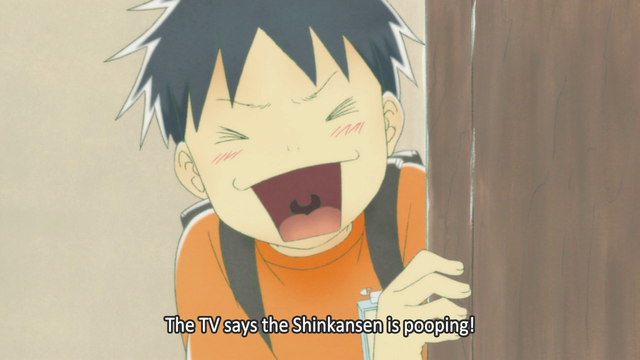
Usagi Drop 09 — The Shinkansen Poops

A Kouki episode. This was probably my favorite episode of Usagi Drop yet. I seem to say that after every episode though…

Kouki is Awesome

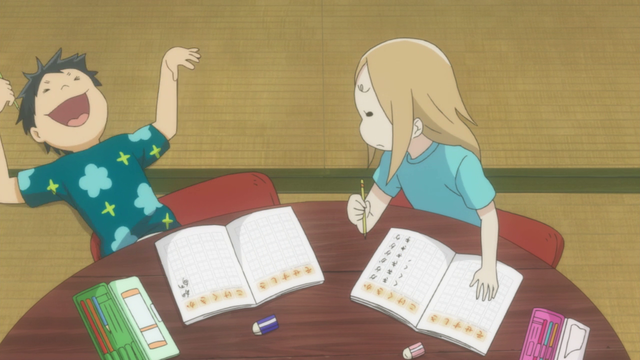
One of the things I like most about Usagi Drop is that it has kids that actually act like kids. Rin’s mature for her age, sure, but not so mature that she doesn’t like jumping around in puddles. And Kouki is even more childish: he acts up to get attention. In this episode alone, he jumped over bushes, asked Daikichi to measure his poop, threw his hat around instead of drawing, jumped in puddles, had fun closing the storm shutters, drew circles in his かs, ate rice with his fingers, and generally made a mess of himself. Both Rin and Kouki are vast improvements over the typical anime child, who is usually either a miniature adult or some disturbing sort of sex symbol.

Kouki’s Relationships with Daikichi and Rin

It’s clear that Kouki sees Daikichi as a father figure. He seems to compete for Daikichi’s attention even more than for his mother’s. He omits the “san” from Daikichi’s name, as opposed to his mother, and as if that isn’t enough, he admires how big Daikichi’s back is. He even clings onto Daikichi and asks to wear his clothes when his mom is right there. He does love his mom though (at least when she doesn’t act like an old hag, as he tells Daikichi).

I loved the scene where Daikichi took Kouki home from the day care. Kouki says goodbye to them cheerfully, as he stares sadly out the window. When Daikichi and Rin simultaneously invite him to come home with them, his face just lights up. He seemed so happy and energetic the whole time they were eating dinner.

Kouki’s relationship with Rin is interesting as well. They’re playmates, but Kouki listens to what Rin tells him despite completely ignoring his teachers.

Random Thoughts

  • Daikichi is quite the gentleman with his umbrella.
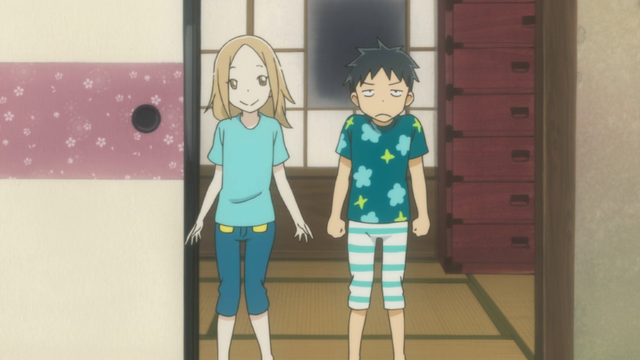
  • Kouki wearing Rin’s clothes was cute. Especially how they’re each wearing the shirt that matches the other’s pants.
  • I noticed for the first time this episode that the music is actually quite good. It’s subdued enough that it doesn’t distract, to the extent that you hardly consciously notice it.
  • Obviously Usagi Drop isn’t going to have enough time to come to a conclusion, but unlike No. 6, this is one show where I’ll be perfectly satisfied with that. From what I’ve heard of the manga’s ending, it’s probably a good thing we didn’t get that far.
Liked this post? Subscribe to our RSS feed and follow us on Twitter!

Steins; Gate 22 — Remember the Future, Change the Past

This was quite possibly the best episode of Steins; Gate yet. This was Christina’s farewell episode, as Okabe left her behind to save Mayushii. In the process Okabe and Christina confess their love for each other. (Thank God we aren’t getting the Mayushii ending.)

The Emasculation of Christina

I found it strange how, at the beginning of this episode, the creators began to ascribe more “feminine” traits to Christina. Before this episode, she was a mad scientist who knew all the 4chan memes. And now, we learn that Christina considers herself “family-oriented” and carries around a sewing kit, we see her breasts and colorful bra exposed through her wet T-shirt, we hear her call Okabe a pervert (but it’s her fault for wearing thin clothes, of course!) and we see her slap Okabe’s face. Christina was always a bit of a tsundere, but the events of this episode seemed out of character.

Then, lo and behold, at the end of the episode Okabe and Christina confess their love. Coincidence? I doubt it. The confession makes the reasons for Christina’s feminization crystal clear. Okabe (and the viewer, by projection) can only love someone who acts like a girl. That’s why without the sewing kit, Ruka has a better chance at Okabe’s love than Christina.

A Reversal of Causalty

Steins; Gate’s view of the multiverse has always disturbed me, because human actions cannot change the future. (On a side note, this fits in perfectly with Okabe’s comparison of his fight to Ragnarok, where the end of the world is pre-ordained.) But the show has always treated fate somewhat inconsistently: Okabe can jump to “nearby” timelines with the memory transfer device and make “minor” changes, but it’s unclear what “minor” means. He is unable to change the hour of Mayushii’s death, but he can change the method.

The result is that Okabe’s actions have no significant effect on the future. This is not to deny Okabe’s free will. To the contrary, he can do whatever he wants, but it is rendered meaningless by fate. This fatalism is odd in a universe where, due to the butterfly effect, a single text message to the past elicits massive changes to the future. But we can resolve this paradox by observing that the d-mail doesn’t change the future: it only brings Okabe to a different universe, where human actions are equally meaningless. This is quite a pessimistic worldview, to say the least.

From Okabe’s perspective, causalty has been reversed: he is powerless to change the future, but has free reign over the past. Effects in the future bring about changes in their own causes.

But as I’ve been saying for a while, and as Christina finally points out in this episode, Okabe’s worldview is quite self-centered. Regardless of his time travel, he does not (and cannot) change the universes he leaves behind. Okabe is truly a time traveler, wandering in search of a universe which is more favorable for him, and for him alone. He is powerless to change the future or the past, and only controls which universe he observes, as if he were changing the channel on the television.

Excellent Dialogue and Mood Setting

The dialogue for this show continues to be top-notch. Let’s take a few examples from Christina and Okabe’s exchanges, which continue to be my favorite parts of the show.

First, we have Christina’s threat, “One more word, and I turn your neocortex into a flower pot!” Now this is how you do an insult! Thank you Steins; Gate for coming up with something besides “Baka!” and a punch to the head. This is an entertaining, unique insult, and serves to properly establishe Christina’s nerd credentials.

To further convince us that Christina is a mad scientist, after the kiss, she says “I didn’t want to do that, ok? But experiences, such as your first kiss, that are stored in the hippocampus with your stronger memories are harder to forget.” This establishes that Christina follows the usual dere-dere pattern. But it does it in a much more interesting way than usual, while also emphasizing the fact that Christina doesn’t want to forget Okabe when he switches world lines.

The creators also excelled at setting the mood in this episode. Take, for example, how after the kiss they ease the viewer out of mushy-mushy land with Okabe’s line, “That wasn’t my first kiss.” and Christina’s subsequent reaction. The mood in Okabe and Christina’s farewell scene was notable as well: a sense of timelessness and a lack of any hurry, yet simultaneously a sense that there is no time left at all. And finally, we have Christina’s perfectly timed entrance to the lab and her answer to Okabe’s confession.

Further Speculations

Shit, Suzuha is back and it’s up to Okabe to stop WWIII. LOLOLOL. Honestly, not much else I can say. Could this be why Christina became the leader of CERN?

If you liked this post, leave a comment and subscribe to our RSS feed!