Hanasaku Iroha 22 — Crushes, Fights and Weddings

A decent episode: finally things seem to be heading somewhere with Ohana, Ko and her family. That said, progress is still slow.

Love is War

The resolution of Ohana and Minko’s fight left me dying of laughter. I don’t think that this is exactly what the creators were aiming for, but we should find enjoyment wherever we can.

After Minko throws the wedding dress on the ground, Ohana tells Minko that she can’t go out with Tohru because she has a “one-sided” crush on Ko. Ohana, do you even know what “one-sided” means? If the guy has already confessed to you and told you he will be waiting, your crush is not one-sided.

Minko proceeds to tell Ohana to die, that she can’t have a one-sided crush, to go out with Tohru, and to die some more. Ohana, in a fit of lucidity, notes that Minko’s demands are inconsistent. They engage in a fight to the death, while Tohru shouts at Ohana how perfect Tohru is, the best of all men.

Nako’s intervention and Tohru’s eavesdropping interrupt their fight, but not until after Ohana gets a trickle of a nosebleed. Tohru lays Minko’s fears that he is in love with Ohana to rest. Minko fails to realize that Tohru doesn’t love Ohana because he sees both her and Minko as children. Then, Tohru pats Minko’s head and tells her that unlike Ohana, she keeps him “in great suspense” (what does this even mean?). Minko breaks down in tears.

At the end, Ohana and Minko reconcile. Ohana realizes she has a “one-sided” crush on Ko. Minko begins fitting for her wedding dress and prepares to become a baby factory. Tohru is still oblivious to Minko’s feelings. Well, at least Ohana did something this episode.

The Wedding

The second half of the episode focused on the wedding. The main ceremony was rather uneventful, but it did make me think a bit about weddings in Japan. It’s interesting how they take all the trappings of Christian weddings and make something rather different. The wedding this week, for example, didn’t even have a minister. My (limited) understanding is that this style of wedding is not at all uncommon, although Shinto weddings are also available.

The wedding’s after party is wild. Ohana’s mother sends a lewd letter, Tohru copies Minko and writes “LOVE” on top of the food, and the writer guy kisses beanman. The music is decent, but that woman has a terrible voice— my ears are still grating just imagining it.

The creators were perhaps a bit too forceful in trying to fit the wedding into the grander purpose of the story. The grandmother’s speech was particularly awkward. Her son just got married, but she says nothing about him and instead talks about how great Ohana and friends are and about the history of the inn? Sheesh, grandma, this is prime roasting time you’re wasting.

Conclusions

At least Ohana seems to be back in the picture now. With the grandmother’s decision that she wants to sell the Kissuiso by the Bonbori festival, we have a clear direction this is heading for in the finale. Ohana and friends will bonboru it up and band together to protect the inn in time for the Bonbori festival, where Ohana will confess to Ko. Hopefully they’ll surprise us and not exactly follow this outline, but it should be a solid ending regardless, even if it could have been stronger if they’d had more of a focus throughout the series.

Into the Leijiverse: Space Battleship Yamato First Impressions

Before yesterday, I had never watched or read a single work by Leiji Matsumoto. Inspired by Animekritik‘s obsession with all things Leiji, I decided that this needed to be corrected. So far, I’ve watched the first five episodes of Space Battleship Yamato, and wanted to share my impressions.

Detailed, Diverse Ships

One of the first things I noticed in Space Battleship Yamato is the amazing diversity of ships and vehicles of all kinds, lovingly crafted in intricate detail, and chock full of dials, gauges and levers. These vehicles aren’t particularly original: take the titular battleship Yamato, which is a WWII era battleship literally plucked from its graveyard and dropped into outer space. The origins of the other ships are equally apparent: we have fighters, stealth bombers, transport planes, missiles, submarines and UFOs. But with their new setting and embellishments, the ships are all entrancing.

Even the non-combat vehicles are fascinating: we have cars that fly through tubes, vans, and short distance fliers which land on skis.

Plus, we have an awesome robot that can split into parts and is a convincing liar.

This raises an interesting question: Space Battleship Yamato was made almost 37 years ago, in 1974. And yet, the first five episodes had a more diverse assortment of vehicles than any show that’s come out in the past five years. What happened? Why are all ships the same now? Now all we seem to get are minor variations on the same Gundamesque humanoid mecha. I know some people follow mecha designs and even build models of them, but I honestly cannot see too much of a difference between different mecha.

Reminders of the Past

Despite being set in the future, Yamato conveys a strong sense of nostalgia. Part of this is that it actually was made a long time ago and the animation shows its age, but it also comes from the WWII era combat set in space. As one example, take the opening battle. It resembles an 18th century naval engagement, with the two opposing forces lining up and exchanging broadsides. It is a throwback to a day where warfare was straightforward and “honorable.”

We also have an encroaching extinction of humanity from nuclear fallout, and the titular Yamato, with part of the second episode even dedicated to telling the WWII battleship’s history. The show does seem poised to take a critical look at the sense of military pride and honor which led the Yamato to its final journey and helped pave the way to the war in the Pacific in the first place. For example, look at the farewell parade and the brother’s pointless death.

In my opinion, WWII has to be one of the most interesting eras in Japanese history. And yet it’s also the least explored in anime, perhaps due to a lingering sense of collective shame and desire to look the other way. The only recent shows I can think of that took place in this era are Senkou no Night Raid and Natsu no Arashi.

Spectacular Scoring

The music is great. As in, Simoun-level greatness. It fits together with the action, and the creators seem to have actually put a lot of effort into it. At the risk of sounding like a grumpy old man, anime nowadays do not seem to put much effort into the music at all, and it often ends up being some crappy J-pop. Of course, there are exceptions.

Imaginative Setting

Yamato’s is a universe of intergalactic proportions. We’ve only been to three planets so far, but each of them has been fascinating in a completely unique way. We have the Earth, which has been destroyed by radiation and is left barren. Then there’s a brief stopover in Mars, which is covered with snow. We also have Jupiter, which has a floating island in the sea of methane which is home to an awesome looking alien base.

Sheer Epicness

Space Battleship Yamato makes the conflict of Gurren Lagan seem petty. Humanity is going to become extinct in a year due to nuclear contamination, and the Yamato has one year to travel 148000 light years to retrieve the aptly named Cosmo Cleaner D which can save the planet. After each episode, a countdown shows how many days remain until the extinction of humanity.

Then there’s the fact that every time the Yamato warps, a slight error on the order of milliseconds on the part of the pilot will result not only in the destruction of the Yamato, but in the destruction of the entire universe. No pressure.

Conclusion

So far, I’m very impressed with Space Battleship Yamato and can see what all the fuss is about. I’m looking forward to continuing watching the show, and hopefully some other works by Leiji Matsumoto as well.

Dantalian no Shoka 07 — Drug Dealers

Nooooooo!!!!

In one of the most strait-laced episodes of Dantalian to date, Huey and Dalian encounter a perfumer who is (unwillingly) selling a drug she created with the aid of a phantom book. Huey and Dalian arrive just in time to witness her family and coworkers killed by the gang they collaborated with. They witness the woman take her own life and destroy the recipe and phantom book in an act of “atonement.”

Heightened Emotional Involvement

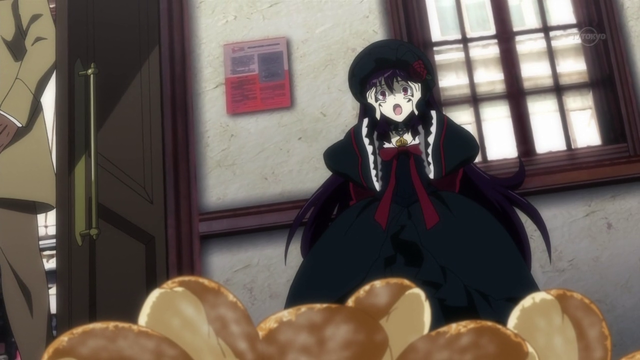
I’ve complained in the past that Huey and Dalian have shown almost no emotional attachment to the cases they’ve been involved in. This may be the first time Dalian has truly become emotionally involved with the people she met. She even shed tears at the woman’s death. And this was the same woman who, horror of horrors, dropped Dalian’s precious bread on the floor.

Dalian even attempted to comfort the woman on her deathbed. As she travels with Huey, is she becoming more attached to the outside world and the passions of the flesh?

A Deeper Magic from before the Dawn of Time

I believe that this is the first time we’ve heard mention of limitations placed on Dalian’s powers as a mystical library. The limitation is that Dalian cannot use a phantom book to save the same life twice. A restriction like this is not all that surprising— powers such as Dalian’s always seem to come with strings attached.

Passerby through Eternity

Jesus said, “Be passerby.”

— The Gospel of Thomas, v. 42


He has set eternity in the human heart; yet no one can fathom what God has done from beginning to end.

— Ecclesiastes 3:11

In each of the earlier episodes, I was surprised at how small a role Huey and Dalian played in resolving the short stories. Yet now I have come to expect it. There is indeed a purpose to Huey and Dalian’s uselessness. They are powerless and impotent bystanders to history, not actors on the stage of time.

The show’s atmosphere provides an acute sense of timelessness and of isolation, both from the scenes with the girl in the library and from Huey and Dalian’s travels. Huey and Dalian don’t form intimate bonds with the people they meet, and many of the people they do meet happen to die. Huey and Dalian have not been able to prevent any of the tragedies brought about by the phantom books or by magic, only to mitigate their effects. The pair continues to travel without a destination or clear purpose. And who knows how many generations Dalian has journeyed for?

References

  • When Huey reads the book of healing, Huey mentions “Arawn, the king of the otherworld Annwn.” This makes the book most likely part of the Mabinogion.
  • The phantom book used for making perfumes is an unnamed Gandharva sacred text. The Gandharva are Hindu nature spirits which dwell in scents and are known for their skill with music.
  • I don’t think I ever mentioned the origins of the library of Dantalian. Dantalian is one of the 72 demons of Solomon mentioned in the grimoire, the Lesser Key of Solomon.

    The Seventy-first Spirit is Dantalion. He is a Duke Great and Mighty, appearing in the Form of a Man with many Countenances, all Men’s and Women’s Faces; and he hath a Book in his right hand. His Office is to teach all Arts and Sciences unto any; and to declare the Secret Counsel of any one; for he knoweth the Thoughts of all Men and Women, and can change them at his Will. He can cause Love, and show the Similitude of any person, and show the same by a Vision, let them be in what part of the World they Will. He governeth 36 Legions of Spirits; and this is his Seal, which wear thou, etc.

  • A similar idea for a mystical library is the subject of Borges’ short story The Library of Babel (Spanish original here). Borges’ library, however, contains all possible books, and not merely Dalian’s comparatively tiny subset of 900,666.

Mawaru Penguindrum 07 — Bewitched

Good lord. This episode was crazy, to say the least. After this, Ringo’s previous actions seem relatively benign.

So right up front, things are not looking up for our friend Shouma:

But even I wasn’t expecting Ringo to infiltrate the school, force Shouma to strip in the middle of a magical circle beneath the light of the full moon, and attempt to spawn frog eggs on his back.

Repressed sexual desire much? Shouma’s dedication to his sister may even surpass Kanba’s.

Ringo as a Witch

I was surprised by this turn of events, but it brought me to an interesting idea: Ringo is a witch. This episode makes her identity as a witch explicit, with the use of magic circles, love potions and frogs. Another item of note is Ringo’s dress: it’s all black. The only parts missing from her costume are the hat and broomstick.

Ringo displays two other components commonly associated with witchcraft, both sexual in nature. First, she is filled with lust, as demonstrated by the fits she goes into when imagining her first night with Tabuki. Second, she is a seductress, albeit not the most skilled one. Both of these attributes are often associated with witches.

And finally, there’s Ringo’s project M, which is itself an elaborate magical spell. Ringo is carefully following the instructions incanting the spell written in the diary spellbook, satisfying all the conditions to achieve her destiny cast the spell to restore her broken family. The spell also serves as a convoluted fertility ritual (more on this later).

This association with witchcraft brought to mind a few further thoughts:

  • Tabuki’s girlfriend is also a witch, but a much more powerful one. And I’m guessing that the woman with the slingshot will turn out the same way.
  • Thinking along the lines of witchcraft, have Kanba and Shouma made a pact with the devil to save their sister?
  • We’ve already tried the throw her in the pond test to determine that Ringo is not made of wood. We should try weighing her against a duck now (a penguin should also work).

Project M

This episode’s big reveal is that the “M” in Project M does not stand for masochist or marriage, but for maternity. A “magnificent and creative plan” indeed, Ringo. Modern girls don’t beat around the bush. Penguin Himari’s reaction to this discovery was priceless:

If we assume that the the slingshot girl has the same goal in mind, Kanba seems to have a stalker as well. Of course, this is by no means a correct assumption, given Mawaru Penguindrum’s propensity for red herrings.

Once again, this fits with the theme of witchcraft, as witches were accused of making pacts with the devil to cause stillbirths, and their carnal lust led them to have sex with the devil and bear his children.

Ringo’s Love Rival

Ringo has pretty much lost at this point to her rival with the announcement of their engagement (not that she had a chance in the first place). I think that Yuri just enjoys playing with Ringo— as I said, she’s an even more powerful witch.

The play was interesting, but unlike other works which skillfully fit a play within a story into the larger context of the whole (see Hourou Musuko, Star Driver, Gunparade March, Hamlet, Rosencrantz and Guildenstern are Dead, etc.) the play here seemed to be largely intended for comic relief, along the lines of Ringo’s delusions. This and a chance for the animators to go wild. The disco ball, the silhouettes in the audience, the roses and glitter falling from the sky and the sparkles combine for quite the visual feast. The play is called “The Tragedy of M: Paris Falls”, but with the M referring to Marie this seems like just a tease. Although I’m sure we could come up with an esoteric interpretation if we tried.

Further Thoughts

  • This show does a great job at putting in amusing details. Tabuki’s bird chirp ringtone, the half eaten sandwiches and the rows of dead cocktails were hilarious.
  • The episode used the phrase “sharing a roof” in two complementary scenes. Ringo’s goal is to share one with Tabuki, and Kanba’s goal is to share one with Shouma and Himari.
  • I am shipping Shouma and Ringo heavily and am quite satisfied with the direction this episode took in that regard. They are quickly becoming more and more comfortable with each other, as evidenced by how they sleep together under the house, and Ringo’s weakening protests about Shouma tagging along with her (to the party for example).

Site Updates

As you have probably noticed, I redesigned the site to feature Shouma and Ringo. Let me know what you think of the design, especially if you find anything difficult to read with the new color scheme. I’m quite pleased with how the banner turned out, my GIMP skills are improving by leaps and bounds.

I now have a public MyAnimeList account. If you also have an account, feel free to add me as a friend. If you don’t, MyAnimeList is a nice site for keeping track of what you’ve watched and look up details about shows (you don’t think I remember all these characters’ names, do you?).

Finally, I’m experimenting with a new post format, of using headings to delineate sections. I feel like my thoughts are much more organized this way. I’m leaning towards continuing to use this format, so let me know if you disagree. I also started taking notes while I watch an episode, which probably helps.


No. 6 08 — The Noble Savage Visits the Oracle

We have a visit to the Oracle, rescuing the forest folk… Is this a bad RPG adaptation now? And we still haven’t gotten inside No. 6 yet?

Engaging Storytelling

In this episode we follow Shion and Nezumi’s journey to the center of the earth. They are brought as prisoners to the great hall of Argatha, where they offer a prayer to the Oracle, surrounded by his ascetic sackcloth-clad followers watching from the balconies. The Oracle was one of the chief architects of No. 6, but was exiled after he discovered what the leadership was up to. He gives Shion a USB key with the results of his research on No. 6 and the parasite bees, of which he was the first victim.

So, let’s review what we learned this episode.

  • No. 6 and the other cities were constructed very recently after all but six patches of land were destroyed in war. I thought it had been much longer.
  • The killer bees are not exactly a new phenomenon.
  • No. 6 eliminates all who come in contact with the bees. So the reason they tried to kill Shion was probably not because he was a dissenter.
  • No. 6 has an evil evil plan. It would take too much time to explain. But it’s evil!
  • Shion’s mother was involved in the construction of No. 6.
  • Nezumi is the last of the Mohicans, who were destroyed by No. 6. This explains why he is so noble (and savage) and why he is one with nature (the king of the rats).
  • The leader of the forest folk, Elyurias (I get the feeling it’s a tree or something), is calling out with its song to Nezumi and Safu.

These are probably the most interesting developments the story has had since episode two. So we’re starting to get somewhere. But I still took issue with the way everything was presented. The oracle asks Shion if he wants to know the truth. And then he just blathers everything to Shion. “Show, not tell” is the saying. And No. 6 just literally delivered an entire episode’s worth of exposition from the mouth of an oracle. An oracle who we didn’t even know existed until this episode. What a great way to tell a story, No. 6. You always manage to keep things exciting.

Overacting

The dialogue continues to feel fake to me. The characters are all highly articulate, complete with hand gestures and dramatic pauses. It’s like they’re acting out a play.

As one example, take Nezumi’s insert song. He comes out singing with a beautiful voice, with perfect posture, arms taut at his side. The cavemen scream in pain in the background (why are they afraid of the song…?). A lighting crew and an orchestra join in to accompany him. Then, for no apparent reason, Nezumi dramatically collapses, as Shion catches him. Ok… why?

For a second example, take the scene where the Oracle says “Elyurias… that is her name.” Nezumi’s gasps and his eyes wobble in fear. Right. Such a scaaary name. Sounds like the name of an angel or something.

And then there’s this scene, where the Oracle tells Nezumi what will happen if he kills the people of No. 6:

How could he possibly not have realized this…? The characters reactions’ are so over the top that I have trouble taking them seriously.

 Speculation

What does the future hold for No. 6? Not much, since there are only three episodes left. And for this show to come to a solid conclusion, they are going to need to pack more into those three episodes than they’ve put into the past six. Good luck with that.