Usagi Drop 08 — Rin’s Mother (and her Old Man Fetish)

I didn’t believe it that Daikichi’s grandfather was actually Rin’s father. I had assumed that he just took in Rin out of the kindness of his heart. But that doesn’t seem to be the case…

Masako’s Roller Coaster of Development

This episode focused on Rin’s mother, Masako. It managed to pull my feelings about her all over the place. At first, the episode made Masako come across as even more pathetic than she had before. Initially, she had seemed to claim that she couldn’t take care of Rin because of difficult personal circumstances, and I had given her the benefit of the doubt that this was the case. But from the revelations surrounding her manga career, the reason seems much simpler: Masako is too irresponsible to care of Rin, and ditched her to become a workaholic. Her career is going well, but she still wants to take more and more work on. To confirm Masako’s workaholism, she screams “I’m not a woman! I’m a manga artist!” and runs out of the restaurant.

At this point, the creators have the viewers (or at least me) looking down on Masako. She abandoned Rin because of her megalomania and fear of being displaced by younger rivals? Daikichi asked for a demotion so he could take care of Rin. This hasty judgement against Masako is strengthened by her appearance— she looks half asleep, with ink marks all over her face, and is snacking on ice cream with her boyfriend. Is Masako really as hard a worker as she claims? She just seems fickle, lazy and irresponsible. Her daughter doesn’t seem to matter to her at all.

And then the creators skillfully take a U-turn and pull our emotions in the opposite direction. When Rin and Daikichi arrive at his grandfather’s grave, they notice that Masako has already placed fresh flowers there. Seeing this, Daikichi becomes angry, as she “didn’t even come to his funeral.” I really loved this scene, because it’s a completely normal (and completely illogical) reaction on Daikichi’s part. It also foreshadows the incoming discoveries about Masako: she really does care about Rin and Rin’s father, but tries not to show it.

Next, Daikichi chases after Masako and tells her she can peek at Rin. I liked how they portrayed Daikichi here: he’s clearly still angry at Masako, and makes a point of telling her that he doesn’t care about her personal circumstances at all and isn’t letting her take Rin. But he also wants to let Masako, as a mother, see her child.

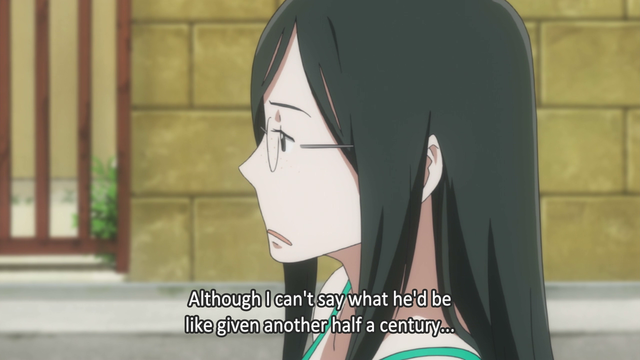
Masako nearly enters shock upon hearing that Rin is nearby, our first hint that Rin means a lot more to her than she is letting on. She decides to peek at Rin through the bushes. She comments on how much Rin has grown. The ink on her face and her detachment are washed away, and she gazes at Rin with  longing and regret. This is the scene where Masako looks the most beautiful, her physical appearance reflecting her inner womanhood which she attempts to deny.

As Masako walks back to the office, she decides she will take the extra job, even though it’s probably more than she can handle. She gave up Rin to work on her manga, but at some level she regrets that decision and feels guilty. So in response, she works even harder on her manga so that she is able to justify that decision to herself. Her claim that she is unable to take care of Rin becomes a self-fulfilling prophecy.

Usagi Drop has been doing great at slowly and subtly building up its characters. It doesn’t have people shouting that they love one another, or talking about what a family is, or trying to make disturbing smiles at their new found siblings. Instead, it focuses on day to day interactions, and shows the character’s thoughts and feelings instead of narrating them.

Animation

I’m continuing to love the bright colors. I realized in this episode what part of the art’s appeal is: many scenes look like they’re drawn with watercolors or crayons, and could have been painted by a child. Which, obviously, fits in very well with the subject matter of the show.

Parent / Child Imitation

One final thing I noticed in this episode is how the creators like to have both the children and the adults imitate each other. Why does this work so well?

  1. It’s funny having kids act like adults and adults act like kids.
  2. It shows how close the adults and children are. The children respect the adults enough to want to imitate them, and the adults love the children enough that their habits wear off on them.

To name a few examples from this episode:

  • Rin imitates Daikichi by lounging around on the porch
  • Daikichi copies Rin and says “Let’s hurry, the stalls will close!” when he gets excited about seeing Yukari in a yukata
  • Kouki copies Daikichi by shouting at him to watch out for cars

Battle Royale: Literary Masterpiece or Trashy Dime Novel?

For many years, I’d been hearing great things about Battle Royale. Everyone and their second cousin told me I just had to read it, and everyone who spoke of it did nothing but gush effusive praise. Last month, I was lounging around on a Saturday, and noticed that my housemate had left a copy of the book on the kitchen table. So I decided to finally take the plunge and read it.

I was hooked, and finished it in a single day. I enjoyed the book: it’s quite the page turner. But that’s pretty much all there is to it: it’s a thriller. Does it have any deeper meaning? Not particularly. Does the book have memorable, well-developed characters? No, they’re mostly cliché cardboard cutouts of each other. Is Battle Royale well-written? No, although I’ll be generous and blame part of this on an awkward translation. Is it as great as everyone let on? No. Is it the “Lord of the Flies for the 21st century,“ as the blurb on the rear cover proudly proclaims? Hell no. Battle Royale is to Lord of the Flies as the Davinci Code is to Foucault’s Pendulum.

It’s no Lord of the Flies

I wouldn’t think that the fact that Battle Royale is completely unlike Lord of the Flies would even bear mentioning, if the book jacket didn’t so obnoxiously proclaim it was and if so many people didn’t seem to believe it (just take a quick glance at the Amazon reviews page for Battle Royale – 111 / 167 reviews are five stars at the moment, with half of them seeming to think it’s better than Lord of the Flies). The main commonalities between the two works are superficial: children travel to an abandoned island and a breakdown of normal civilization occurs.

First of all, the conflict in Battle Royale comes across as black and white. The children (except for the few that enjoy killing their classmates) are the good guys and the organizers of the game are the bad guys. It’s the bad guys that are ultimately responsible for everyone’s deaths. There’s never any doubt of this. In Lord of the Flies, there are no organizers forcing the children to kill each other. They have absolutely no excuse for killing Piggy: it doesn’t even particularly benefit them to do so.

Battle Royale had to invent a boogeyman out of the autocratic government of Japan (which, I should point out, doesn’t appear to even have the tacit support of its citizenry as in most dystopian works).  In Lord of the Flies, the boogeyman comes from within innocent children, making it a much more stark and relevant commentary on humanity. One of the most haunting images of the book is when the Royal Navy ship, outfitted for war, appears on the horizon to bring the children back to the cradle of “civilization.” Battle Royale, on the other hand, is a simplistic, stark battle between good and evil, with clearly defined villains— the government and Kazuo.

Repetitive Story Arcs

After a while into the “game”, you can pretty much tell how the rest of the chapters involving the side characters are going to go. Here’s an outline.

  1. Two characters randomly meet up. They had some relationship before they were thrown on the island: either lovers, friends, or one-sided admiration, typically.
  2. They each fret over whether the other one is going to kill them or not.
  3. Someone dies. Possible causes:
    1. Intentional backstabbing.
    2. Accidental backstabbing due to confusion.
    3. Lover’s suicide.
    4. They reconcile and swear their eternal love / friendship, only to have someone else jump out of the bushes and kill them both. They die in each other’s arms.
  4. Repeat ad nauseum.

So the story is rather formulaic. There are a few more interesting segments: the introduction, the very end, and the short subplot involving Shinji’s attempts to sabotage the game, at least until he runs into Option D.

Still, the arc format would have some potential, if it weren’t for…

Formulaic Characters

All of the side characters are defined entirely by one or a combination of the following traits: membership in a school club, a tragic past, or a lover. None of them really get much depth. They don’t stick around long either, so from what I can tell, the only reason for any of them to even exist in the story is so that they can die a tragic death. Of course, the fact that their development is so shallow makes their deaths all the less tragic. For the most part, I couldn’t care less. And once again, the repetitive story format made me care even less about each individual death.

The main characters are also not too interesting. The male lead, Shuyo, is your standard loser harem protagonist, with the twist that he likes rock music, which the autocratic government frowns on it. This serves as an excuse for the author to add misplaced Bruce Springsteen references (more on this later). To continue our analogy, Noriko, the lead female, is the girl in the harem with the personality of a wet sponge that the male lead inevitably picks. She is quiet, and spends most of the novel asleep or injured. She is the sweet and innocent princess that our manly lead must protect.

Next is Shogo. Like many of the side characters, he also suffers from tragic past syndrome. He is on a quest for vengeance, and pursues this coolly and efficiently. The biggest issue I have with him and the other lead characters is that they just feel so fake. Shuyo is boring, Noriko is an angel, and Shogo is a cool, suave machine who always knows what to do and executes things perfectly.

Finally, we come to our villain Kazuo. He is simply the devil incarnate, with no positive traits to speak of. There is some half-hearted attempt to blame this on a birth defect. Not exactly the most compelling villain. The characters are, to be frank, simply not particularly interesting.

Subtlety and Depth

A big thing which bothered me is just how subtle this book is. For example, there are some obvious Orwellian influences surrounding the setup of the dictatorship. But instead of showing us the TVs that can’t be turned off, that we have always been at war with Eurasia, and that everyone loves Big Brother, the author just decides to have Shuyo tell us everything in a huge info dump. Not exactly the best storytelling there. As another example, each of the characters is introduced through narration rather than through action or dialogue. The author didn’t get the memo on “show, not tell.”

The author also likes to make references to Bruce Springsteen’s rock and roll, which is all about rebelliousness (?). The book ends with a quote from the lyrics of Born to Run, as Shuyo and Noriko quite literally run away from the police.

Baby this town rips the bones from your back
Its a death trap, it’s a suicide rap
We gotta get out while were young
`Cause tramps like us, baby we were born to run

The novel refers to Springsteen’s song in the literal sense of running away and the figurative sense of fleeing from a physical death. To make an analogy, this would be like Murakami writing a novel about Norwegian lumberjacks.

Conclusion

Battle Royale was an entertaining book, but it certainly wasn’t “the Lord of the Flies for the 21st Century.” I highly doubt that most people will have heard of it fifty years from now.

What were your thoughts on Battle Royale? Am I an elitist prick? Feel free to share your thoughts in the comments below!

Steins; Gate 21 — The Hostage has Escaped

Through death.

So this was another Mayushii episode, the calm before the storm in which Okabe spends some time with her before the final battle.

I’ll be honest: with Okabe’s all-encompassing drive to save Mayushii, I’m surprised that even Christina’s impending death was able to sway him from his course. But as Mayushii dies again and again, I expect him to at least attempt something (if Christina doesn’t do it herself first). Christina’s death may be the key to preventing Mayushii’s death: her murder is much more suspicious than Mayushii’s diverse array of deaths, and seems to have a clear-cut cause other than the spirit of the universe conspiring against her. This also means that it will be easier to prevent. And who’s to say if Mayushii won’t die just a day later in the original universe as well? What Okabe really needs to do is bring the watch to get repaired, that should keep her going for a few more years.

This episode continued to bring home how unavoidable fate is in the Steins; Gate multiverse. Okabe tried to commit suicide to save Mayushii, only for her to jump in front of the car to save him. The only way to change fate is to run away to a different timeline. But this seems to me like an intrinsically selfish action, unless we accept the notion that there is one true universe, the one Okabe inhabits. Otherwise, the characters in all the other universes are still left to their fates. It is only Okabe that gets a happy ending. In this sense, to say that Okabe is doing everything for Mayushii’s sake is foolish. The Mayushiis that will die, will die, regardless of Okabe’s actions. The only thing he controls is whether he lives in a universe with a living or a dead Mayushii.

On her deathbed, Mayushii confesses that she is grateful she was finally “useful” to Okabe. Of course, Okabe does not feel the same about this particular act of “usefulness,” but regardless… She mentions the same thing on the phone, that she is being a burden to Okabe. And then once again in the graveyard, where she worries about Okabe’s suffering. My guess is that Mayushii’s realization of self-worth will be integral to her eventual salvation.

The bleeding over of the parallel universes continues in full force, with Mayushii now remembering her own deaths and all of the lab members, including Suzu who she should have never met in this timeline. Soon everyone will be seeing Steiner. The only one left is Christina, and once she does remember the past universes, I’m sure she’ll make more sense of things than Okabe.

Speaking of Christina, the dialogue between her and Okabe continues to be superb, twenty episodes later. Here’s my favorite sequence from this episode:

Ah, I can’t get enough of this. I’m kind of surprised Okabe actually thought he was fooling anyone though. The next episode should be good: it looks like it will be Christina-centric, with her hunting the building she was killed in for clues.

Hanasaku Iroha 21 — The Bitch is Back

The old Minko returns.

There was a lot going on in this episode: Enishi and Takashi decide to get married, the inn prepares to host their wedding, and Minko throws a fit.  The part about the wedding was good, except for the couple acting all love-dovey. I didn’t think these two could possibly get more annoying, but I’ve been proven wrong. I especially liked that we got to see a bit more of the grandmother’s past.

Minko’s trip to the beach with Tohru was entertaining, where he reveals he wants five kids. Minko isn’t so sure about that plan. She wants to have his children, of course, but five seems a bit too many. Tohru realizes that Minko is upset about something, and thinks it is about the difficulties of becoming a chef. Man this guy is dense. Minko gives a near-confession, and then Tohru starts talking about how great Ohana is. Minko gets jealous and returns to her old ways of calling Ohana names and attacking her in the bath.

So… I guess this is a step towards more drama? Another fight with Minko is not exactly what I had in mind though. In the earlier episodes, it added a lot because we didn’t actually know Minko yet, and Ohana was having all these other difficulties moving to the inn. But now, it just really doesn’t raise the tension for me. How are we supposed to take this fight seriously? We all know that Ohana has no interest in Tohru, that Minko likely has no chance with Tohru, and that Minko throws fits like this all the time. They’ll reconcile in a day or two. The funny thing is, Ohana seems to just be rolling her eyes at Minko’s routine as well. She doesn’t even bother chasing after Minko after being assaulted in the bath. When Minko shuns her at lunch time, Ohana just goes to eat with Yuina and Nako. Now that Ohana actually has some friends, Minko’s fits are less effective. In fact it’s probably backfiring, as Minko is the one without any friends now.

The ending of the episode, where it’s revealed that Enishi won’t be inheriting the inn, seems to be the lead in to the show’s conclusion. I’m guessing that either Ohana or her mother will become the heir, or the grandmother is planning to shut the inn down. The latter option seems more likely, since then there will be some final battle: Ohana and friends must save the inn from closure. I do hope they resolve Ohana’s love life though. Or realistically, just have Ohana do anything other than smile and look cute. It’s been how many episodes now since anything happened involving her?

Dantalian no Shoka 06 — Magical Lyrical Libricide

One thing I can say for sure about Dantalian: it never does what I expect it to. This episode came as another big surprise. The creators completely ditched Dalian and Huey to instead focus on a new pair of Phantom Book collectors— Flamberge, the bearer of the long-lost library, and her keykeeper Hal, a Libricide. The two have some feisty banter similar to Huey and Dalian, but their game mainly focuses on insults such as “piece of junk”. It became a bit repetitive in comparison to the more original infighting we’ve become accustomed to.

I spent most of the episode wondering when Hal was going to fulfill his title of Libricide and start burning books. But I was still surprised by how he did it— by placing a book into his Raging Heart-style staff of Sutr and burning it to cast a powerful single use AoE spell. It’s a cheap shot but limited ammunition.

I have to wonder— the title of Libricide suggests that Hal and Flamberge’s goal isn’t to prevent the misuse of Phantom Books and collect them, as with Huey and Dalian, but to eradicate them and their influence on humans. Will this be a cause of conflict between the two groups in the future? Dalian has the world’s largest library of Phantom books, after all, and didn’t worry about letting those children who were corrupted by the books live. And it appears that the two keepers from this episode are chasing another book keeper who gives away books. I kind of thought it was Dalian at first, but I highly doubt she would give away books like that. This episode seems as if it could be the beginning of an overarching conflict.

One last thing about the two book keepers: try comparing how their books are extracted. Flamberge’s extraction resembles a Caesarean section. Hal reaches in to pull a beast out of the womb (or fallen world) as Flamberge screams in pain. On the other hand, Dalian’s extraction sequence is dignified and nearly orgasmic. Dalian loves books so checking them out is pleasurable, and the checkout counter is located near her heart. Flamberge and Hal seem to despise books, so checking one out is painful and the checkout counter is located in the nether regions of Flamberge’s body.

This episode’s villain and short story were solid, but it was more by the book (ha ha ha ha) than what we’ve become accustomed to: a woman raises an army of puppets to comfort the living in a town devastated by war.

This week’s book is a collection of Taoist sutras. The most famous Taoist work is the Tao Te Ching, if you’ve never read it before then knock yourself out, it’s great. The other item of interest is Hal’s staff, the staff of Surtr. Surtr is a Norse giant who will destroy the world at Ragnarok with his flaming sword (sword / staff, close enough).