Tag Archives: review

Hidan no Aria Review — D

Kinji is a Butei, a student attending a school for mercenaries. On the way to school one day, he is attacked by a team of robotic Segways. He is cornered, and a transfer student, Aria, comes to his aid. She loses some of her clothes, and when Kinji is aroused, he enters Hysteria mode, where he becomes a powerful player (in every sense of the word). The rest of the show follows their adventures in their attempts to help their friends and to free Aria’s mother from prison by clearing the false charges against her.

Ok, so this is variations on Shakugan no Shana #10. The main difference from the previous versions being that, in addition to swords, Rie Kugimiya also has guns now. She’s still an annoying tsundere loli with all the other usual baggage though. In terms of annoyingness, I would loosely rank things, from least annoying to most annoying, Shana << Lotte << Louise << Aria << Rose.

JC Staff didn’t seem to know what to do with only a single cour for Aria. The light novels clearly span much more material than can fit in a single season, and they didn’t do too well at picking and choosing parts to make a solid story. We have a bunch of characters who only show up in one or two episodes: Jeanne d’Arc, Reki and the final bad guy are all pretty much single use characters. Reki has a half episode where she tames a wolf, but aside from that her importance is nearly moot. Shirayuki gets an arc of a few episodes, but otherwise isn’t much important. And we’re introduced to Kinji’s ex-girlfriend (?) in the last episode, but she never even speaks. All in all, they failed at creating a continuous narrative.

Another issue is that the creators appear to pull a lot of crap out of their rears. Characters are made descendants of random historical figures for no apparent reason, and everyone acts as if this makes sense. The final bad guy is a teacher that has done nothing whatsoever  up to that point. Girls strip their clothes off in mid-air and their uniforms double as rocket parachutes. The final boss is a gurgling vampiric minotaur. Guns are used to precisely shoot mid-air wolves’ spines to temporarily paralyze them. And the list goes on.

With all that said, there were some good points to the show. Mainly that, aside from Aria, the characters were likeable. Kinji, the male lead, is not your typical loser protagonist, at least when he goes into Hysteria mode. Shirayuki and Riko, two of the major side characters, are downright insane, Shirayuki in a protective / obsessive way and Riko in a more traditional way. I always love the crazy people. As far as fanservice goes, Riko is a pretty good source (except for her parachute- that’s only good in the so bad it’s funny sense), but Aria is unfortunately both a terrible and more common source of fanservice.

I would say that overall I despised Aria the character, but found the rest of Hidan no Aria decent. Unfortunately Aria is the star of the show.

  • Plot / Script – 6 / 10 – Lots of things came out of nowhere, and it didn’t come together well.
  • Characters – 5 / 10 – Hated Aria, liked most everyone else (esp. Riko).
  • Production – 7 / 10 – About average.
  • Overall – D

Recommendations – Shakugan no Shana, Zero no Tsukaima, Isekai no Seikishi Monogatari

Note: I’m still away on a trip, and will be back to a semi-regular schedule next Wednesday.

The World God Only Knows II Review — 6.5 / 10.0

I really like The World God Only Knows’ manga, but the animated adaptation has fallen flat for me. One of the reasons, I feel, is that a lot of the humor has been lost in the transition to television. The creators of the TV show seem to think that capturing the girls is actually important: in the manga, it comes across more as simply a device (and a stupid one at that) to make fun of Keima and galges, at least until the latter chapters which this series hasn’t gotten to. I don’t care about the girls Keima is capturing, I want to see what idiotic things Keima will do. How is it even possible to take luring out loose souls to stuff it into a giant vacuum bottle seriously? The only part of this season that I found funny was the last episode, especially the Gundam parody.

The second issue I see with the anime is the pacing. It just feels like they could tell the entire story in half the time. Do they really need three episodes for every single girl, especially when they aren’t using the time to make me laugh about Katsuragi? They seem to feel the need to dedicate at least one episode to each girl’s internal monologue about her problems. This is said so often I’ll risk sounding trite, but “show, don’t tell.”

Lastly, the characterizations of Keima and Elsie seem off to me. Particularly Elsie: in the manga she is a complete joke whose only valuable functions are holding the capturing bottle and drooling over fire trucks. Here, again, the creators seem to want to take her seriously. Part of the problem is that she’s even more annoying when she actually has a voice. For Keima, again, they try to take him too seriously, but another issue is his casting. I can’t quite put my finger on why, but his voice just doesn’t fit my image of him.

Whining about how the manga is better aside, the biggest problems are that the show just isn’t all that funny, drags on and on, and in terms of a plot, nothing really happens that isn’t reset within three episodes. There are some good points to the series, just don’t set your expectations too high. The second season was better than the first, if only for the addition of Haqua. If it’s an option, I’d recommend reading the manga over watching the anime.

  • Plot / Script – 6 / 10 – Too slow and not funny enough.
  • Characters – 7 / 10 – God is not extreme enough, Elsie is annoying, all the supporting characters get a few episodes and get ditched.
  • Production – 6 / 10 – Very underwhelming.
  • Overall – 6.5 / 10

Recommendations – Baka to Test to Shoukanjuu, Welcome to the NHK

Softenni Review — C+

Softenni is Xebec’s latest seasonal offering of fanservice. It’s about a group of soft tennis players who are aiming for the Wimbledon. Needless to say, they don’t make much progress, but instead get caught up in bizarre situations such as riding giant bears, wrestling whales, riding bouncy balls while wearing neko-mimi, and getting launched into the air like rockets by soft tennis balls. There’s also a ton of fanservice.

From the perspective of a plot and character development, there’s basically nothing (well, aside from the last episode, which was more of an afterthought and also the worst episode of the show). Most of the characters are one trick ponies. Kurisu wears costumes and is really good at tennis. Chitose is ridiculously weak, but becomes a monster when food is involved. The ghost girl talks to ghosts (she was introduced in one of the last episodes, so I have no idea what the point of even adding her was). Eli speaks “English”. Massage boy gives massages. The list goes on.

But the focus of this show is on the comedy and the fanservice, and it does a pretty good job at both of these. Its sense of humor is quite random, but I found the show funny most of the time. Softenni has ridiculous soft tennis matches reminiscent of Saki’s Mahjong, yuri implications, hunting and gathering, delusions, cows, and more.

The fanservice is rather bizarre, which at least made it interesting enough that I could sit through it. My favorite parts were everything involving the national champion (cat ear girl shown above) and Asuna’s delusions. She’ll misinterpret things to have sexual innuendos and put sparkles and lipstick on everyone.

Softenni won’t be remembered for a great story or characters or… well, anything, but it was still a fun watch. It’s definitely a vast improvement over Xebec’s recent offerings in this genre, such as MM, Rio, and Ladies vs Butlers, in that it’s not only an excuse for fanservice. (It’s still mostly an excuse for fanservice though.)

  • Plot / Script – 8 / 10 – Humorous and kept my attention.
  • Characters – 7 / 10 – Quite shallow, but fun and entertaining.
  • Production – 7 / 10 – Nothing special.
  • Overall – C+

Recommendations – Saki, Tantei Opera Milky Holmes, Galaxy Angel

Oretachi ni Tsubasa wa Nai Review — B+

In the biggest surprise of the spring season, I actually enjoyed Oretachi ni Tsubasa wa Nai (We Don’t have Wings). In my initial preview, I called it “terrible even by the already low standards of perverted harem shows.” I decided to drop it after a little girl started making dirty jokes and showing people her underwear. A few weeks later, I decided to give the second episode a shot, and I was hooked. So what happened?

The first episode was indeed terrible, and my opinion of that hasn’t changed. I was a misguided attempt to hook the viewer and introduce all of the characters at once, through heavy use of fanservice. But from the second episode on, things really get going.

First of all, the dialogue, scripting and pacing in this series is spectacular. It doesn’t feel like a moment is wasted, and the conversations are always witty, informative and non-repetitive. This show just has a ton of energy behind it which transfers over to the viewers. The excellent dialogue in turn results in strong characterizations, especially the male leads. The supporting cast is extensive and well-developed as well. Also, the fanservice in this show is quite creative and random. This is the kind of fanservice I can live with.

Many shows of this ilk suffer from the weak male protagonist syndrome, where the male lead is a loser who is surrounded by a bunch of interesting female characters who are in love with him for no apparent reason. Oretachi does not suffer from this problem at all: in fact, I would argue that the male characters are more interesting than their female counterparts. They’re assertive, witty and suave, which is quite a change from your usual harem protagonist.

Last but not least, the creators managed to arrange a harem where the main character has mutual romantic interests with multiple girls while not being an indecisive man-whore. They deserve mad props just for this. I won’t spoil it, but suffice to say that you’ll be quite confused for the first half of the show trying to figure out what’s going on, until everything just clicks. Interestingly, one of the main characters doesn’t even make an appearance until the fifth episode. In this regard the creators managed to introduce some element of a mystery into the show as well.

Oretachi ni Tsubasa wa Nai comes highly recommended for its intense and original script, its strong characters and its all-around uniqueness and creativity in the rather stagnant harem / galge adaptation genre. Don’t be put off by the first episode like I was (actually, you might want to just skip it).

  • Plot / Script – 10 / 10 – Fast-paced and witty.
  • Characters – 9 / 10 – Superb male leads in a genre dominated by terrible ones.
  • Production – 8 / 10 – Nothing that really stands out, either positive or negative.
  • Overall – B+

Recommendations – Ichiban Ushiro no Daimaou, Durarara

Ano Hi Mita Hana no Namae wo Bokutachi wa Mada Shiranai Review — A-

Ano Hi Mita Hana no Namae wo Bokutachi wa Mada Shiranai (We Still Don’t Know the Name of the Flower we Saw that Day, or Ano Hana) begins with Jinta, a hikikimori and soon-to-be high school drop out, meeting the ghost of the girl he loved as a child, Menma. In a fit of youthful passion, he told her she was ugly and ran off, and she died before he could meet her again. Menma’s return leads Jinta both to reunite with his other childhood friends in their efforts to grant Menma’s wish so that she can be reincarnated, and to confront their own pasts.

Ano Hana’s greatest strength lies in its impeccable characterizations and emotionally charged script. All of the characters are both sympathetic and deeply flawed. Each of them gets their chance in the spotlight and makes strides towards overcoming their weaknesses, although no one fully resolves all their problems by the end of the story. The side characters also have a chance to shine, particularly Menma’s family. The story is quite emotional, with many tearjerk moments. Expect to cry multiple times while watching Ano Hana.

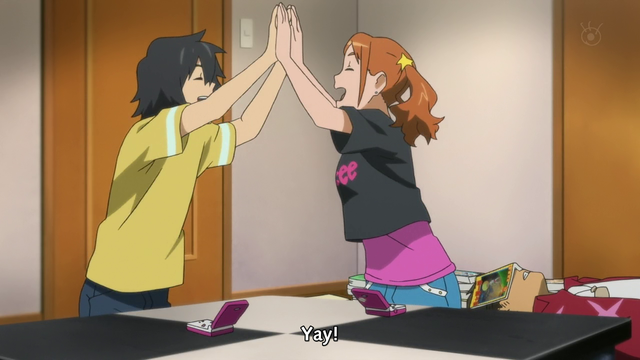
For me at least, part of the appeal of Ano Hana is the nostalgia factor. As high schoolers, Menma’s friends have a chance to return to their secret clubhouse and to trade Pokemon. I had my own trip down memory lane and returned to the secret clubhouses of my past. Mine was inside a pine tree, so I wasn’t quite as spoiled. (Back in my day, we walked ten miles to school through the snow everyday and it was uphill both ways… but I digress.) It makes for an interesting setup to see high schoolers interacting with their friend who hasn’t grown up and is still a child.

I don’t particularly have anything negative to say about Ano Hana: it perhaps didn’t have the most ambitious plot, but its superb execution and characters more than make up for this, and the simple story becomes one of its strengths, with only eleven episodes to spare. Ano Hana, for me, was the highlight of the season, and it comes highly recommended.

  • Plot / Script – 9 / 10 – Moving, emotional script.
  • Characters – 10/ 10 – Consistent and believable characters with depth and multiple facets, memorable interactions between them.
  • Production – 9 / 10 – Above average, enabled me to become engrossed in the story but did not overshadow it.
  • Overall – A-

Recommendations – Asatte no Houkou, Welcome to the NHK, Haibane Renmei