Tag Archives: review

Fractale Review — C-

Fractale is an adventure set in a world where a system of satellites, the Fractale system, runs to maintain a virtual world in conjunction with the real world which satisfies basic necessities and allows people to interact with dopples, virtual avatars. Clain meets a girl, Phrynne, a priestess and Nessa, a dopple, who are the key to restoring the breaking-down Fractale system. The three travel together while avoiding the forces trying to capture them.

The main problem with Fractale is that the use of time is terrible, which really matters in an eleven episode show. The middle episodes were a complete a waste— they added only inconsistent information about the world which didn’t relate to the titular Fractale system, and were more or less long sequences of jokes about how Clain is a pervert. They weren’t even funny. Then, of course, because so much time was wasted, the ending was rushed. The series asks so many questions, but doesn’t look at any of them in detail.

Fractale has an interesting setting, certainly, but it is treated so inconsistently and without lead-ins that it seems fragmented and not like a single world. Initially, it seems that everyone in the world lives alone in trailers, and Clain’s living in a house is a social taboo. But not long after we meet rebels who live in a town. Then there are refugees fleeing from a town destroyed when parts of the Fractale system shut down. Can’t they just pick up and move if they live in trailers? Then we jump to a decadent city run by shepherds, and a secret base with robots and clones. It just seems like the creators didn’t know what to do with the setting and changed their mind every episode. The world of the first episode didn’t seem anything like the world of the final episode, and they weren’t able to build a consistent and believable world.

In addition, the creators don’t really address any of the issues raised by the Fractale system at all after the first episode. Clain’s parents raised an interesting question in the first episode, saying that asking people to live together infringes on their freedom. It’s never mentioned again. There are some references to “data drugs”, but it never plays much of a role. Plus, it’s never explained why everyone is so dependent on the Fractale system. It doesn’t grow food, does it? And you can’t live in virtual houses, even though the refugees seemed to- Clain did fall through the floor of one. At the end of the show, the characters end up restoring the Fractale system, but no reason is given. They came to destroy it and ended up fixing it, but why? It just seems like they’re going with the flow. In general, the show ignored the interesting questions in favor of Clain being a pervert.

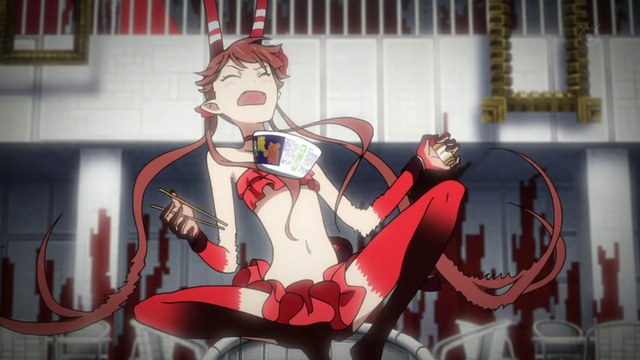
Fractale also had a strange mix of a peaceful, beautiful Ghibli-esque setting with acts of brutality. One minute we’re laughing and running through the trailer park, the next we’re gunning down innocent bystanders, getting raped and stabbing people. There’s hardly any transition between the two, and I couldn’t really take the violence seriously due to the rest of the show. It just seemed completely out of place.

  • Plot / Script – 6 / 10 – Too much time wasted on Clain being perverted, not enough time on the Fractale system. Inconsistent world-building.
  • Characters – 7 / 10 – Clain gets annoying because of all the jokes surrounding him, and the main villain is a complete joke, but otherwise interesting (particularly Nessa and Phrynne).
  • Production – 8 / 10 – Great animation, especially when they try, such as the scene with Nessa’s mischief in the trailer park and the town market.
  • Overall – C-

Recommendations – Ghibli Movies, Dennou Coil

Infinite Stratos Review — D

Infinite Stratos : Generic Harem #237 (plus mecha). Ichika goes to an all-girls school for IS (mecha) pilots and becomes a pimp. Infinite Stratos has quite literally the most generic harem plot you can imagine. In the first episode, Ichika moves to an all girls school. He meets his long-lost childhood friend, Houki. And what a surprise, Ichika discovers that they are roommates when he walks in on Houki in the shower! The first episode was so terrible that I thought it was a parody. Unfortunately, I was being much too generous.

Basically everything that Hourou Musuko did right, Infinite Stratos did wrong. The characters were boring, cliched and inconsistent. We have a straight-laced Japanese childhood friend who practices Kendo, a snobby British girl, a Chinese girl whose family runs a ramen shop and who is also a childhood friend, a cross-dressing French girl (this character was actually decent), and a militaristic German girl who makes a sudden and unexplained transformation into a defenseless moeblob.

But even worse than the vapid characters is the fact that the creators focus on one character for a couple episodes, and then proceed to push them into the background and forget about them. Houki showed up for the first episode and the last two but basically didn’t do anything in the middle. The same can be said of all the other characters as well: they have their two episodes in the spotlight and are discarded, hidden in the recesses of Ichika’s harem.

The creators also decided to go for a dramatic, meaningful and deep psychological ending with everyone joining their power to protect their comrades. With the desire to protect their comrades, the inherent powers of their IS awaken and they power up to defeat the enemy! (my explanation isn’t quite all there is to the ending… for one thing, it makes much more sense than the actual show) This was seriously one of the cheesiest endings I’ve seen in a while. I wish that the creators of shows like this could accept that they don’t have any deep meaning, and trying to make it look otherwise isn’t fooling anyone, only inducing pain and suffering for the viewers. The only reason anyone watches this show is for the stupid harem hijinks, and it’s better to just continue with that than to try to make the final episodes of the show into something it’s not and fail miserably.

There were some good points to this show though. For one, the arc with the French girl, Charles, was actually pretty decent. But my standards may have been set pretty low because of the rest of the show. Also, the animation and choreography of the battles was generally well done, but it would have been more effective had I actually cared about the characters in the fights…

  • Plot / Script – 5 / 10 – About as generic as it gets.
  • Characters – 5 / 10 – Poorly developed and quickly discarded.
  • Production – 7 / 10 – Good fight scenes and consistent animation, but otherwise does nothing to stand out.
  • Overall – D

Recommendations – Isekai no Seikish Monogatari, Love Hina, Zero no Tsukaima, etc…. if you like this kind of thing, there are a million ones that are better.

Hourou Musuko Review — A

Hourou Musuko (Wandering Son) tells the story of Nittori Shuusuke as he begins the difficult transition through puberty. Shuusuke and his friend Takatsuki are both uncomfortable with their assigned gender, and prefer to adapt the mannerisms and clothing of the opposite sex. Horou Musuko explores the growth of them, their friends and their classmates.

Chiba is awesome.

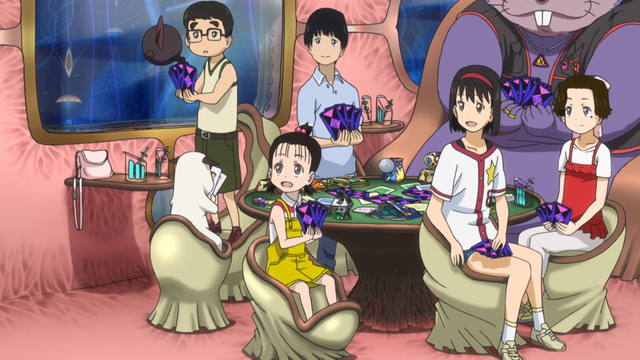
The strongest aspect of Hourou Musuko is the cast – for a show of only eleven episodes, the number of characters is astronomical, and all of them are well-developed. The creators did an amazing job at utilizing the limited time to the fullest extent for character development. One very effective technique which I haven’t seen to such an extent anywhere else is quite simple in principle: in a scene with multiple characters, one character will say or do something, and the rest will react simultaneously. Nearly every show has scenes like this. But usually all the characters have the same reaction. This is where Hourou Musuko stands out: instead of reacting the same, the scene is set up so that the characters can, no, must, react differently based on their personalities (see the image below: count five completely different reactions). From casual interactions in scenes like this, we can, in a short amount of times, glimpse deeply into multiple characters simultaneously. This technique helped Hourou Musuko to develop such a large and strong cast in a short amount of time.

The other thing which makes the characters stand out is that they treat different people differently. This is obviously true in real life, but anime often neglect this, having characters interact with their close friends, family and complete strangers in the same way. But consider Maho, Shuusuke’s sister: she treats her brother like a creepy little brat to his face, tries to get her friends to cheer him up behind his back, acts like a fashionable teenager with her modelling friends, and is shy and demure with her boyfriend. Maho’s relationships make her feel like a real person instead of a cardboard character cutout.


The script flows extremely well, which, for a show that jumps around between scenes and characters as much as Hourou Musuko, is quite an accomplishment. The decision to skip over the beginning of the manga turned out well, since it allowed the show to use its limited time to cover the more interesting parts. This may have the effect of leaving first-time viewers of the series a bit lost trying to figure out who all the characters are, but stick with it, you’ll figure it out in a few episodes and be grateful for the choice in the end.

  • Plot / Script – 9 / 10 – Smooth, timely scripting, particularly in the many scene changes, which are nearly unnoticeable in how little the flow is interrupted.
  • Characters – 10 / 10 – A large, strongly-developed cast: approaches Simoun in ambition as a character study.
  • Production – 9 / 10 – Unique, beautiful style – I especially love the faces and the shininess of the hair.
  • Overall – A

Recommendations – Simoun, Aoi Hana

Kore wa Zombie Desu Ka?! Review – B-

Kore wa Zombie Desu Ka?! follows the recently deceased Ayumu as he begins life as a zombie, living with Eu, the necromancer who revived him, Haruna, a magical girl, and Sera, a vampire ninja. Ayumu soon absorbs Haruna’s powers and becomes a magical girl himself. Our hero’s party battles fleets of flying whales, crazy women, giant stuffed animals and golems using the power of a magical girl’s chainsaw, leaves, and ramen.

I’ll be the first to admit that most of this show doesn’t make any sense whatsoever. But who cares? Making sense is boring. And Kore wa Zombie Desu Ka is certainly not boring. There were a few episodes in the middle where the show attempted to be serious and make sense (it actually didn’t do too bad, either) but fortunately the creators abandoned this endeavor and went back to the ridiculousness that made the show so much fun to watch in the first place.

One thing which I found that the show does particularly well at is combining the plot (such as it is) with comedy. Anime often have a tendency to focus only on comedy or only on the plot exclusively, and they’ll often end with a “climax” of sorts which is entirely serious and drains all the fun out of the show. Kore wa Zombie Desu Ka?! does an excellent job avoiding this: they even have the main antagonist tell a completely non-sensical joke and relive all the tension right at the peak of the climax.

The characters start out seeming annoying: Haruna has a cheerful, genius-level idiocy and refuses to wear pants; Sera is only capable of cussing; and Tomonori takes the role of the young “wife”. But all of them eventually grew on me as they played more of a role in the show. Harun’s genius became more idiotic, Sera’s disses improved from the initially generic insults to ones more specific to Ayumu and the situation, and Tomonori was sat on by a humongous stuffed animal and transformed into a golem.

Overall, I recommend giving this show a watch if you’re looking for some brainless humor.

  • Plot / Script – 8 / 10 – Not so much in the way of a plot, but consistent and fresh jokes.
  • Characters – 8 / 10 – Start out seeming annoying but quickly gain traction.
  • Production – 7 / 10 – About average in animation.
  • Overall – B-

Recommendations – Ichiban Ushiro no Daimao

Onii-chan no Koto nanka Zenzen Suki Janain Dakara ne!! Review — D

Onii-chan no Koto… shows the life of Shuusuke and his harem of three girls: his (adopted) sister Nao, his childhood friend and freakish stalker Iroha, and class president / closet BL-lover Kondou. The show got off to a strong start in the first few episodes, but managed to lose most of its momentum in the middle by repeating the same jokes over and over again. It was funny the first time Iroha spied on Shuusuke through her telescope and they formed a chain of five people stalking each other. It was less funny six episodes later when Nao and Iroha had done nothing the entire time except follow Shuusuke from the shadows.

The characters could have been interesting, and were when they were first introduced, but quickly lost steam when the creators had them do the same jokes over and over. Nao especially is a fun character to watch as she plots ways to seduce her unwitting brother and loves him for how disgusting and pathetic he is: but in the second half of the series she was basically relegated to a background stalker. Nao’s two friends make an excellent counterweight to her obsessiveness, but they disappeared about halfway through the series. Iroha was amusing for the first episode… but again, after ten episodes of doing nothing but stalking, it can get a bit stale. Her unexplained unholy alliance with Nao throughout the middle of the series didn’t help, as one of the more amusing aspects of her character was giving Nao someone to fight with. Kondou was entertaining when she was having Shuusuke buy her BL books, but after she discovered Shuusuke’s nipples the creators pushed her into the background as well. So all in all, the characters were interesting but poorly utilized.

  • Plot / Script – 3 / 10 – Most of the jokes are used up in the first episode. Six episodes of Nao and Iroha stalking Shuusuke from the shadows are not funny.
  • Characters – 7 / 10 – The characters themselves have potential to be entertaining (particularly Nao and Shuusuke, when he actually does something) but they’re used poorly.
  • Production – 8 / 10 – The animation is definitely unique and enjoyable, particularly the distorted faces. The music and voice acting was not so great.
  • Overall – D

Recommendations – Ore no Imouto…, B Gata H Kei