Tag Archives: review

Hitsuji no Uta Review — 8.5 / 10.0

Hitsuji no Uta (Lament of the Lambs) is a short OVA from eight years ago. It tells the story of a high schooler named Kazuna, who is reunited with his sister whom he hasn’t seen since he was three years old. The two have a hereditary vampiric disease where they desire blood, and begin to live together as a family, pushing away their friends and Kazuna’s adopted family.

The creators did a good job at building a tense, dark atmosphere. The colors in the animation are used to especially good effect. There are no people with random blue, green and pink hair colors here: everything is dark shades of black and brown. The character designs actually look like real people and not animified. They even have freckles and hair that could conceivably grow on a human head.

On the negative side, the use of flashbacks was a bit much in the first two episodes. The final episode was much stronger than the first three, if only because a lot more happened then. The doctor is just kind of hanging around for the first three episodes, but he really becomes an interesting character in the final episode. Revelations from the final episode also make you see the sister and the family in a quite different light. This is probably more a reflection of how good the final episode and its build up were than any issue with the earlier episodes.

  • Plot / Script – 8  / 10 – A strong storyline, but plot and dialogue repeat themselves a bit much especially with flashbacks
  • Characters – 9 / 10 – The main character’s choices particularly regarding his family could have been better explained. The sister and doctor are very interesting characters, although their stories aren’t revealed until the end.
  • Production – 9  / 10 – Good use of color, although looking aged now.
  • Overall – 8.5 / 10

Recommendations – Ghost Hound, Tsukihime

Toshokan Sensou Review — B-

In the world of Toshokan Sensou (Library Wars), the national government has established a censorship law which the armed Media Cleansing Committee enforces by burning books. In response, the provincial governments have created the Library Force to protect books from censorship in libraries. Toshokan Sensou follows Kasahara as she joins the elite Library Task force.

The show is a mashup of Fahrenheit 451 (more on this later), a war show, and a corny romance. The romance wasn’t actually that bad, I’m just not really into that kind of thing (from the Tatami Galaxy: “There’s nothing more boring than a successful romance”). The military parts of the show were well done, with good action scenes.

The setup is certainly creative, but isn’t entirely believable. Japan has laws which allow open warfare between their own countrymen in open daylight. How could anyone possibly tolerate this? I mean, I think most people would prefer either censorship or no censorship to open warfare in the streets. There were a few other things that didn’t make much sense: for one, we had a pacifist who refused to resist the censors. Then when she is going to get fired from her job she picks up a pistol, shoots someone, and lights herself on fire with her own library. So much for pacifism. So the show requires some suspension of disbelief, but this isn’t too much of a problem.

Now for the Fahrenheit 451 comparison. This show includes references to Fahrenheit 451 as the “Book of Prophecy” which predicts book burning. But unfortunately, this show isn’t really much of a critique of censorship like Bradbury’s book. The reason the main character joins the Library Force is because her “Prince” was in the Library Force and protected her book. The commander founded the Library Force because his wife was killed by the censorship force. And most of the censorship forces are mercenaries (except for the one character with the cleansing committee who has a face, who has “personal connections” and also dislikes censorship). So the censorship forces are rather unambiguously evil. Also, in Fahrenheit 451, the government was more or less just expressing the will of an empty society in burning books: in Toshokan Sensou, most people either support the libraries or are indifferent. (Ok, they claim a majority of people support censorship at some point, but we never even meet any of these people, if they actually exist)  So there is a clear boogeyman in Toshokan Sensou, while for Bradbury the entire society was to blame.

One of the things that made Fahrenheit 451 great is how it showed the effects of censorship on a society and how devastating and hard escape from they are. But here censorship is more of an abstract thing which makes people get shot, or gets some little kids’ books taken away. For a show which is about the suppression of ideas, there are far too few ideas to go around.  Another problem is that the world is static: Montag and his world become more and more interesting as he uncovers more about it and learns to despise what he used to be. In Toshokan Sensou there is no growth. The world more or less is and remains the way it initially appeared.

Still, overall I greatly enjoyed this show— it’s completely unfair to compare it to one of Bradbury’s masterpieces. One of the more interesting aspects for me was seeing the cultural political differences. Americans tend to be less ambivalent about censorship than most of the world, for one thing, although we certainly have our fair share of censorship advocates. A lot of Western works focus on censorship as well, but the same can’t be said of anime. The ending of the show also felt extremely Japanese: after something that wasn’t really his fault, the commander of the Library Forces tragically steps down to “take responsibility”, as the rest of the forces honored him. This took most of an episode with much crying. I was kind of just rolling my eyes.

  • Plot / Script – 9  / 10 – Creative setting, interesting short stories
  • Characters – 8  / 10 – Distinctive and enjoyable, although small in number
  • Production – 8 / 10 – Consistent, nothing spectacular
  • Overall – B-

Recommendations – Planetes, Nodame Cantabile (for the romance), Book of Bantorra, Read or Die (for the books)

Puella Shoujo Madoka Magica Review — A-

I held off for nearly a month on writing this review because I forgot was thinking deeply about what to say. Madoka by far was the most popular show of the spring season, and with good reason. For me, the best part of the show was all the twists and turns in the plot— it really kept you coming back for more, wanting to know what would happen. Madoka was the show I looked forward to each new episode of the most since Code Geass aired. I won’t spoil any of the plot twists, but will just say that many were shocking and unexpected. Everything is wrapped up in the end, although the ending for Madoka was kind of silly.

Madoka also stands out for its excellent cast of characters. The weakest is the titular Madoka, but her indecisiveness serves as the main driving force behind the show. The villain, Kyuubey, will be remembered for a long time. This is how you make a great villain – not someone who cackles evilly while destroying the world, but someone who considers what they’re doing good. Sayaka, Kyoko and Homura also turned into detailed, sympathetic characters.

Shaft went all out on the production for this, and it shows. The battle scenes especially are spectacular. Shinbo needs to do more shows like Madoka and forget about all the crap sequels and moe shows that SHAFT has been churning out lately.

Anyway, don’t be deceived by the title— Madoka Magica is a show about magical girls, but it isn’t a show for little girls. Expect something dark and violent.

  • Plot / Script – 9 / 10 – Plenty of twists and turns, great mystery development.
  • Characters – 9 / 10 – Excellent, especially for Sayaka, Kyoko and Homura
  • Production – 10 / 10 – Beautiful, especially the fights and witches’ worlds
  • Overall – A-

Recommendations – Noein, Mai-HiME, Narutaru

Moshidora Review — B

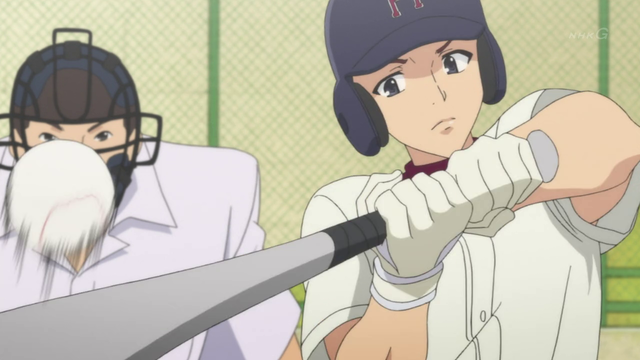
Long title: What If a Female Manager of a High School Baseball Team Read Drucker’s Management. The premise doesn’t seem very promising, but the show did manage to come together nicely. It’s quite corny, there’s no getting around that, but the show has a certain earnestness and straightforwardness which makes me forgiving of the cheesy drama and predictable events. It’s like the creators know the show is corny, but instead of trying to gloss over it they just face it head on. I found it kind of refreshing.

The highlight for me was the segments involving Drucker’s book. We learn about marketing, the customers, and innobetion. It’s hilarious how all of the baseball team managers end up getting their own copy and quote from it like it’s the Gospel. All with their curious pronunciation of key words. 🙂

The characters are interesting, but don’t all get enough time to develop in the short length of the show. I don’t think that much could have been done about this. The characters do tend to be rather corny again, but I find that part of the charm. Yuki is is the stereotypical kind sickly girl, Minami is mostly average all around and hates baseball for the corniest reason imaginable, freckle boy is a nervous wreck,  etc. My personal favorite is Ayano, whose main line is “Um. Ah. Hai”.

The corniness did cross the line on the second to last episode, though, when the whole cast spent the entire episode wailing. Minami’s ranting also made no sense whatsoever. I felt that this was by far the weakest point of the entire show and completely out of place in a show which was otherwise entirely upbeat. Fortunately in the final episode it managed to recover its mood, but the damage was already done. The creators seemed to also entirely forget about Drucker for the last few episodes, which made for some of the best segments originally.

  • Plot / Script – 9 / 10 – Corny but overall solid.
  • Characters – 8 / 10 – Again, solid, but not too much depth.
  • Production – 8 / 10 – Not spectacular, but decent and consistent.
  • Overall – B

Recommendations – Giant Killing, Kamichu

Yumekui Merry Review — C-

Dreameater Merry: Shakugan no Shana III. Merry=Shana, Yumeji=Yuuji, Yui=Yoshida. About half the show consisted of battles in dreams, and the fighting was quite well done. Except most of the battles were two people talking about how they believed in themselves and explaining their attacks. I shouldn’t be surprised by this though, considering the track record of all shounen fighting shows ever created. The other half of the show consisted of people looking beyond the camera from one side of the screen and tilting their necks with the wind blowing through their hair. Sure, it’s a nice pose, but when it’s the only pose in your show there’s an issue.

With that said, I largely enjoyed Yumekui Merry overall. Sure, it doesn’t have the most original plot or the best dialogue, but its excellent execution helps to make up for that. The visuals and music are both fantastic, especially for the scenes in the dream world.

  • Plot / Script – 7 / 10 – Fairly predictable plot, dialogue is often overly sentimental and preachy.
  • Characters – 7 / 10 – Yumeji and Merry struck me poorly because their main pastime seems to looking cool and posing. The two main antagonists didn’t really do much except laugh evilly too.
  • Production – 9 / 10 – Gorgeous visuals and the music fits very well.
  • Overall – C-

Recommendations – Shakugan no Shana, Pandora Hearts