Tag Archives: review

Level E Review — B+

After watching the first episode of Level E, I decided against blogging it because nothing much seemed to be happening and it wasn’t all that funny. Boy was I wrong. The entire first episode was simply a setup for the amazing twist the creators were preparing for episodes two and three. This just goes to show not to judge anything by its first episode.

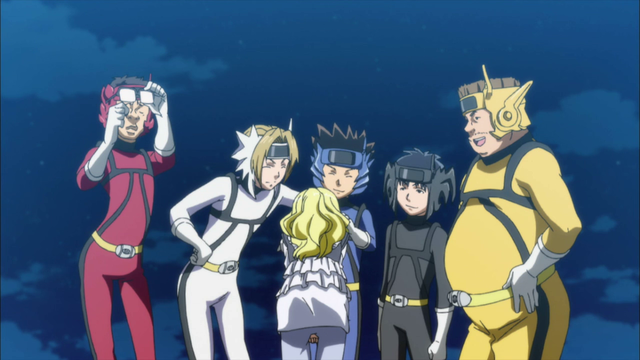
The series is a collection of short stories centered around Baka-Ouji and other aliens living on the Earth. Prince Baka spends most of his time goofing off by playing elaborate pranks on random people, so most of the humor centers around this. The short stories have enough variety that it doesn’t get stale— we have a murder mystery, a power rangers parody, a romantic comedy, and intergalactic politics, all with twists which make the stories not quite what they seem.

My personal favorite part of this show was Kraft, the Prince’s retainer who is most affected by his pranks and is always trying to kill or oppose him, but ends up falling into his schemes anyway. He provides a “sanity” check on the prince, but in doing so has ended up becoming even more insane.

On the negative side, none of the story arcs are really on part with the first one. This is a comment more on how great the first arc was than on the others, which are still hilarious (particularly the final arc). I think the main reason is that after the viewers are aware of the prince’s true nature, it isn’t so easy to be fooled anymore.

  • Plot / Script – 9 / 10 – Great buildup and execution of the jokes.
  • Characters – 8 / 10 – Strong characters, but doesn’t focus too much on individuals due to the arc nature of the show.
  • Production – 8  / 10 – Consistent animation.
  • Overall – B+

Recommendations – Gintama, Oh! Edo Rocket, Galaxy Angel

Star Driver Review — B

Star driver stars Takuto, a Ginga Bishounen (Galactic Pretty Boy), as he transfers schools to an island in search of his father. The island has a hidden secret: cybodies, powerful humanoid creations which give their users immense power, but are sealed by the island’s maidens. Takuto becomes embattled in trying to protect the maidens from a secret organization, the Glittering Crux, comprised of his schoolmates, that is trying to break the seals. The show is divided between ordinary school life and ritualistic battles reminiscent of the writer’s other work Revolutionary Girl Utena.

Star Driver did an excellent job at character development— it started out with some completely ridiculous characters and made them into actually likable people. Probably the best example of this is Kanako. She starts out as a young bride who married into wealth and is quite proud of it. She lives on a luxury cruise ship, has two live-in servants and a pet alligator. She kisses random people at school through a glass window. Yet by the end of the show, the creators manage to turn her into the most prepared and dependable character there is. Most of the other characters the creators spent time on become interesting characters in their own right as well— but due to the short nature of the show, this didn’t include everybody. The development was especially lacking around the main villain’s allies.

Star Driver is a fun show. It has fantastic characters and an interesting setting. It does an excellent job at building up the characters and revealing the layers of the mystery. It keeps you sitting on the edge of your seat and waiting to see what will happen in the next episode. But the biggest problem is that it wasn’t really able to pull everything together for the conclusion. I think it was a bit too ambitious for the amount of time it had, and could have used another twelve episodes.

Still, the buildup is certainly worth watching, and the journey’s more important than the destination, right?

  • Plot / Script – 8 / 10 – Excellent plot and storytelling, except for the end. Some time was wasted in the middle with too much school antics and random lesbian enemies appearing out of nowhere.
  • Characters – 9 / 10 – Large cast of characters, many of them with substantial depth.
  • Production – 8 / 10 – Consistently good animation. Nice explosions.
  • Overall – B

Recommendations – Utena, Mai HiMe, Code Geass

Toaru Majutsu no Index II Review — C-

I’ll confess, the main reasons I’m still watching this are for Biri-biri, to see what’ll get hacked on next to Crystal Dragon Jesus, and to see which girl Touma is going to punch in the face next. Index II has made especially good progress in the last category.

Index II has followed in the footsteps of the first season, maintaining more or less the same quality. It’s good for what it is, a fun action show, once Touma decides to stop talking to his enemies or on his cellphone and punch people. I felt like there were less Touma monologues in this season, so that’s good.

My favorite part about this series is the setting. It’s quite imaginative, and gives a sense that there’s a lot more to it than their showing. Building a world like this is an ambitious project, and the creators are doing well with it. Magic is awesome, espers are awesome, and crystal dragon Jesus is awesome.

The biggest problem is the characters. Not that they’re uninteresting; to the contrary, the characters are very strong. The problem is that there are too many of them and they never get enough attention. I mean, look at that maid girl who sits on the robot— she appeared in the ending credits, but who was she again? Himegami, Komoe-sensei and even Index barely showed up. It would help if they found a way to make more of the characters play a role in each of the arcs, since right now only a few characters take part in each one.

  • Plot / Script – 7 / 10 – Great world-building, but Touma can be talkative and preachy.
  • Characters – 7 / 10 – Strong characters, but they don’t get enough attention.
  • Production – 7  / 10 – Consistent but fairly standard.
  • Overall – C-

Recommendations – Asura Cryin’, Shakugan no Shana, Legend of Legendary Heroes….

Fractale Review — C-

Fractale is an adventure set in a world where a system of satellites, the Fractale system, runs to maintain a virtual world in conjunction with the real world which satisfies basic necessities and allows people to interact with dopples, virtual avatars. Clain meets a girl, Phrynne, a priestess and Nessa, a dopple, who are the key to restoring the breaking-down Fractale system. The three travel together while avoiding the forces trying to capture them.

The main problem with Fractale is that the use of time is terrible, which really matters in an eleven episode show. The middle episodes were a complete a waste— they added only inconsistent information about the world which didn’t relate to the titular Fractale system, and were more or less long sequences of jokes about how Clain is a pervert. They weren’t even funny. Then, of course, because so much time was wasted, the ending was rushed. The series asks so many questions, but doesn’t look at any of them in detail.

Fractale has an interesting setting, certainly, but it is treated so inconsistently and without lead-ins that it seems fragmented and not like a single world. Initially, it seems that everyone in the world lives alone in trailers, and Clain’s living in a house is a social taboo. But not long after we meet rebels who live in a town. Then there are refugees fleeing from a town destroyed when parts of the Fractale system shut down. Can’t they just pick up and move if they live in trailers? Then we jump to a decadent city run by shepherds, and a secret base with robots and clones. It just seems like the creators didn’t know what to do with the setting and changed their mind every episode. The world of the first episode didn’t seem anything like the world of the final episode, and they weren’t able to build a consistent and believable world.

In addition, the creators don’t really address any of the issues raised by the Fractale system at all after the first episode. Clain’s parents raised an interesting question in the first episode, saying that asking people to live together infringes on their freedom. It’s never mentioned again. There are some references to “data drugs”, but it never plays much of a role. Plus, it’s never explained why everyone is so dependent on the Fractale system. It doesn’t grow food, does it? And you can’t live in virtual houses, even though the refugees seemed to- Clain did fall through the floor of one. At the end of the show, the characters end up restoring the Fractale system, but no reason is given. They came to destroy it and ended up fixing it, but why? It just seems like they’re going with the flow. In general, the show ignored the interesting questions in favor of Clain being a pervert.

Fractale also had a strange mix of a peaceful, beautiful Ghibli-esque setting with acts of brutality. One minute we’re laughing and running through the trailer park, the next we’re gunning down innocent bystanders, getting raped and stabbing people. There’s hardly any transition between the two, and I couldn’t really take the violence seriously due to the rest of the show. It just seemed completely out of place.

  • Plot / Script – 6 / 10 – Too much time wasted on Clain being perverted, not enough time on the Fractale system. Inconsistent world-building.
  • Characters – 7 / 10 – Clain gets annoying because of all the jokes surrounding him, and the main villain is a complete joke, but otherwise interesting (particularly Nessa and Phrynne).
  • Production – 8 / 10 – Great animation, especially when they try, such as the scene with Nessa’s mischief in the trailer park and the town market.
  • Overall – C-

Recommendations – Ghibli Movies, Dennou Coil

Infinite Stratos Review — D

Infinite Stratos : Generic Harem #237 (plus mecha). Ichika goes to an all-girls school for IS (mecha) pilots and becomes a pimp. Infinite Stratos has quite literally the most generic harem plot you can imagine. In the first episode, Ichika moves to an all girls school. He meets his long-lost childhood friend, Houki. And what a surprise, Ichika discovers that they are roommates when he walks in on Houki in the shower! The first episode was so terrible that I thought it was a parody. Unfortunately, I was being much too generous.

Basically everything that Hourou Musuko did right, Infinite Stratos did wrong. The characters were boring, cliched and inconsistent. We have a straight-laced Japanese childhood friend who practices Kendo, a snobby British girl, a Chinese girl whose family runs a ramen shop and who is also a childhood friend, a cross-dressing French girl (this character was actually decent), and a militaristic German girl who makes a sudden and unexplained transformation into a defenseless moeblob.

But even worse than the vapid characters is the fact that the creators focus on one character for a couple episodes, and then proceed to push them into the background and forget about them. Houki showed up for the first episode and the last two but basically didn’t do anything in the middle. The same can be said of all the other characters as well: they have their two episodes in the spotlight and are discarded, hidden in the recesses of Ichika’s harem.

The creators also decided to go for a dramatic, meaningful and deep psychological ending with everyone joining their power to protect their comrades. With the desire to protect their comrades, the inherent powers of their IS awaken and they power up to defeat the enemy! (my explanation isn’t quite all there is to the ending… for one thing, it makes much more sense than the actual show) This was seriously one of the cheesiest endings I’ve seen in a while. I wish that the creators of shows like this could accept that they don’t have any deep meaning, and trying to make it look otherwise isn’t fooling anyone, only inducing pain and suffering for the viewers. The only reason anyone watches this show is for the stupid harem hijinks, and it’s better to just continue with that than to try to make the final episodes of the show into something it’s not and fail miserably.

There were some good points to this show though. For one, the arc with the French girl, Charles, was actually pretty decent. But my standards may have been set pretty low because of the rest of the show. Also, the animation and choreography of the battles was generally well done, but it would have been more effective had I actually cared about the characters in the fights…

  • Plot / Script – 5 / 10 – About as generic as it gets.
  • Characters – 5 / 10 – Poorly developed and quickly discarded.
  • Production – 7 / 10 – Good fight scenes and consistent animation, but otherwise does nothing to stand out.
  • Overall – D

Recommendations – Isekai no Seikish Monogatari, Love Hina, Zero no Tsukaima, etc…. if you like this kind of thing, there are a million ones that are better.