Ikoku Meiro no Croisée Review — B-

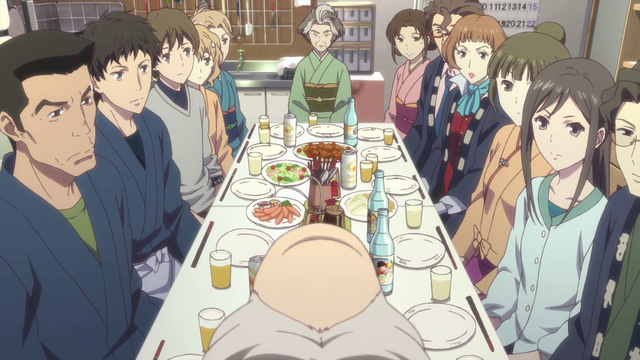
Yune, a young girl from Japan, comes to work as an apprentice in a sign making shop in Paris. She helps out at the shop and makes friends with the neighbors. We get to explore some of the cultural differences between France and Japan.

First of all, this series is downright adorable. Yune is ridiculously cute, as is everything she does. This is coupled with some beautiful animation, so if you like cute things, this is the show for you.

The episodes are, for the most part, entertaining. The creators manage to come up with a variety of new situations to place Yune in— getting robbed by the orphan boy, becoming lost in the neighborhood, and playing with her neighbor Alice. The characters on the main cast are compelling and likable. Alice begins as extremely irksome, but wins the viewer over as her sister and background are introduced.

But on the negative side, Ikoku Meiro is more fluff than substance. Many people may not see anything wrong with this, but I prefer shows with a bit more depth (or humor in its stead). There’s some tragic backstory about Claude’s past and Yune’s sister, but it doesn’t really go anywhere, and just serves to add a tiny splash of drama. Likewise, the cultural differences tend to be superficial. One episode about how the French look down on the poor and the Japanese love them and are charitable had me especially rolling my eyes. Furthermore, the cultural differences are largely forgotten for the second half of the series.

So if you go into Ikoku Meiro expecting a cuteness overload, you won’t be disappointed. If you’re looking for more, well, don’t set your hopes too high.

  • Plot / Script – C – Script is decent, but the story doesn’t really go anywhere.
  • Characters – B – Yune is cute.
  • Production – A – Very pleasing to the eye.
  • Overall – B-

Recommendations – Aria, Usagi Drop, Kamichu

Liked this post? Leave a comment, subscribe to our RSS feed, and follow us on Twitter!

Shinryaku!? Ika Musume — First Impression

Have no fear, Ika-chan, this isn’t the end!

The second season’s title is differentiated by an added question mark. That’s so last year. They should have gone with Shinryaku! Ika Musume’.

Anyway, it’s back to the same sort of comedy we saw in the first season. The first segment has Ika-chan finish watching a movie about alien invaders who are tragically defeated. She goes around mistaking everything for weapons to be used against her, and ends up getting in trouble with Chizuru. A good way to reintroduce all the characters without things getting tedious.

The second segment features Sanae getting jealous over squid girl’s new friends. Sanae deduces that she’s in last place in terms of squid girl’s possible lovers, but decides it’s better to be hated than to elicit feelings of indifference. Ika-musume verbally abuses Sanae, she seems to enjoy it.

We end with a jellyfish catching competition. Squid girl uses her tentacles to great advantage, but tangles herself up and gets stung. The scientists cheat and win.

I’m not going to blog this, since (as you can see) I usually have very little to say about comedies. There’s nothing more boring than someone explaining what was funny. I’ll definitely be watching though— it seems to have retained the sense of humor that made the first season so successful. Let’s just hope they don’t run out of jokes and use the same ones over and over again. Most long-running comedies seem to fall prey to that eventually; hopefully Ika Musume will be an exception.

Liked this post? Leave a comment, subscribe to our RSS feed, and follow us on Twitter!

Tiger and Bunny Review — B+

In Tiger and Bunny, a group of superheroes defends the city from criminals, but with a twist— the heroes compete for points on a reality TV show. Our hero, Kotetsu, is a middle aged man, a single father whose daughter doesn’t know he is a hero. He gains a new partner, Barnaby, who he begins to fight crime with. But the crime may reach deeper than he believes…

Much of the show is spent developing the individual heroes. Everyone except Rock Bison gets their turn in the sun, and in general, the show does quite well at it. Blue Rose is a bit frustrating, as she’s in love with someone twenty years her senior, but it isn’t too much of an issue. Kotetsu in particular stands out. He’s kind of a loser, but is very personable, and his kindness and commitment manage to earn everyone’s respect. His occasional bursts of idiocy manage to keep things entertaining as well.

The rest of the show is spent unearthing a criminal conspiracy surrounding Barnaby’s past. It was suspenseful, with many twists and turns, and thoroughly satisfying.

The ending was a let-down, as the creators were absorbed in advertising the sequel, but otherwise Tiger and Bunny was one of the most solid series of the season.

  • Plot / Script – B – Compelling, with many twists and turns.
  • Characters – B – Kotetsu is one of the best characters of the year, although the others were somewhat lacking.
  • Production – A – Very consistent.
  • Overall – B+

Recommendations – Starship Operators

Liked this post? Leave a comment, subscribe to our RSS feed, and follow us on Twitter!

Hanasaku Iroha Review — B

Ohana’s mother falls deep into debt and runs away from home with her boyfriend. Ohana is sent to the Kissuisso, an inn run by her grandmother, who she has never met. Her presence meets with harsh resistance from the other inn residents. Will Ohana be able to fit in to her new lifestyle?

Hanasaku Iroha can be great when it wants to. It’s had some of the best drama of the year. There are a few excellent dramatic arcs, in particular: the first few episodes, the middle episodes, the one Yuina episode, and the ending.

But the problem is that for the rest of the time, the creators of Hanasaku Iroha don’t try to make it great. The other episodes are episodic and meandering, focusing on a character or two. They’re enjoyable, but don’t pack nearly the same impact the more dramatic episodes do. It becomes yet another show about cute girls doing cute things, when it could have been so much more.

As for the characters, I loved how the show explored Ohana’s family and their relationships across three generations. Her grandmother was a particularly memorable character. Ohana herself, though, was not terribly interesting, although her cheerfulness kept things fresh. Her boyfriend was even less memorable. Minko, one of Ohana’s friends, was particularly annoying: she kept throwing these giant fits over nothing, the show would make a big deal of how she changed and grew up, and then she’d do the exact same thing a few episodes later.

Overall, Hanasaku Iroha is excellent when it focuses on the drama, but merely average for the rest of the time, when it’s all about cute girls doing cute things. Those episodes hold neither the charm nor the humor of, say, K-On.

  • Plot / Script – B – Mixed thoughts. Fabulous for the dramatic episodes, but quite weak in the rest.
  • Characters – B – Excellent characterization with Ohana’s family, but weaker with Ohana herself and some of the side characters.
  • Production – B – Consistent, detailed animation. Nice landscapes in particular.
  • Overall – B

Recommendations – AnoHana, Sora no Woto, K-On

Liked this post? Leave a comment, subscribe to our RSS feed, and follow us on Twitter!

Hanasaku Iroha 26 — I Want to be Like Grandma

Dawww. What a great finale.

The First Five Minutes

The first five minutes of this episode were simply beautiful. I would have been perfectly happy if the show ended at the point where they showed the episode title. What was it about this intro that made it so engrossing, and the most memorable segment of Hansaku Iroha to date?

The first reason it stands out is because of the festival atmosphere. The chanting in the background and the light of the lanterns bring the viewer into a mystic reverie.

It uses this reverie to lead the viewer on a trip of fleeting whimsy. Ohana’s mother jokes around with her grandmother, asking her to buy a candy apple, and reading other people’s wishes aloud. Minko fights over letting Yuina and Nako read her wish, while Ohana and Ko have an awkward encounter at the yakisoba stand.

This trip of transience culminates in both a realization of change and a restored union with the past. Ohana and Ko become a couple, as Ohana looks back on her own past. Sui finds solace in how much she has come to mean to her granddaughter, while looking coming to terms with her past and present as well. So what I’m trying to say is that the show uses these small, whimsical, and humorous events to showcase the monumental transformations the characters have undergone.

Ohana’s Confession

I loved the confession scene. In your typical confession scene, the girl and boy will confront each other from a long distance, completely alone in their own little world. “I… I… I love you!” one of them shouts. The other returns the confession, they run towards each other and embrace.

Hanasaku Iroha has had a lot of fun playing with this trope. In Tokyo, we had the scene where Ko and Ohana were on opposite sides of the bridge. Prime confession material, here. It even ends the episode on the bridge as a cliffhanger. But nope, no confession.

Then in this episode, Ohana and Ko confront each on the sidewalk. The passerby blur, and Ohana and Ko are all alone. “I… I… I like… like… yakisoba!” Foiled again.

Ko and Ohana head to the yakisoba stand. Ohana has her face down, ashamed at her failure. “I… I have to tell him!” she thinks to herself. Ohana and Ko make small talk as they wait for their yakisoba.

“I like…”

“Yeah, I like the yakisoba at night stands better too” says Ko, finishing her sentence.

“It’s Ko-chan!” Ko blushes and turns to face Ohana. “I like Ko-chan! I love you!”

The passerby continue walking past, indifferent to this earth-shattering development. The yakisoba vendor hands them their order. It’s shaped like a heart. Ko and Ohana turn bright red.

This confession was just so fresh. It took your expectations, threw them out the window, and the scene was all the better for it. It was beyond awkward, as most confessions tend to be, and it was visibly difficult for Ohana.

Further Thoughts

There was a lot more to this episode, but as far as I’m concerned the show should have ended with the grandmother’s musings as she looked into the night sky. That’s not to say the rest of the episode was bad: it was fabulous too. It was just unnecessary. Ohana has made her decision, as has her grandmother. The rest is just details.

With that said, the sequence where the grandmother tours the Kissuiso for the final time, only to find Ohana hasn’t quite left yet, was also breathtaking.

One final thought: Tomoe and Ren look like a couple at the festival.

Liked this post? Leave a comment, subscribe to our RSS feed, and follow us on Twitter!