The best part of this show so far. When Shuu asked Inori why she said she would stay with him forever and all that:


AHAHAHAHAHAHA Continue reading Guilty Crown 05 — REJECTED
The best part of this show so far. When Shuu asked Inori why she said she would stay with him forever and all that:
AHAHAHAHAHAHA Continue reading Guilty Crown 05 — REJECTED

The mysteries are finally starting to unravel. Unfortunately this means there’s less to speculate about. There is one big reveal though: the Takakuras’ father isn’t dead. He seems to be heading the mysterious organization that Kanba has been getting money from. Now, what is its purpose?
Another item of speculation: are the people Masako wants to crush Himari and Shouma? She says “I can’t leave Kanba with them any longer” as they’re having a family hug at the end of the episode. Very interesting.
The way the scenes were arranged in this episode was beautiful. Let’s take a look at a few of them.
 First, consider the opening scene about Tabuki and his childhood with the piano. There’s some interesting texturing here, it looks like it was done with watercolors. And the picture of the faceless boy with the hat really reminds me of some painting I’ve seen before. Does anyone who knows more about art recall what painting this is?

The scene in the child broiler was beautiful as well, particularly when Momoka ripped her way into it. What a boss. Notice the lighting and the shadows.

I appreciated everything that took place at the top of the building as well, but I particularly liked the scene where Ringo is gripping the door of the elevator. Half her face is enmeshed in shadow, and the reflections on her eyes wobble gracefully.

My favorite scene from the episode was the family hug at the end though. Shouma is holding both Himari and a wounded Kanba in his arms. And then Ringo joins in from behind. Damn. Shouma sure is loved. This was just adorable.
This is the second time we’ve seen the child broiler. The first time was during Himari’s sojourn to the library: she met a mysterious boy there who gave her an apple (I’m guessing it was Mario).

In this episode, we learn that Tabuki went to the broiler because he was an unwanted child, unloved by his mother because he couldn’t play the piano. So why was Himari in the child broiler? She was certainly loved by her parents and by her brothers.
In the picture above, Momoka looks somewhat sinister. I wonder if she has a dark secret as well.
Tabuki makes an interesting statement about Momoka:


Tabuki believes that Momoka should not have died: she was supposed to be the savior of the world. This is much like the disciples prior to the resurrection: they thought it was ridiculous that Jesus would die, because he would lead them to rebel against the Romans.
Tabuki later claims, “I’m a victim whose most precious person was killed in your parents’ attacks.” I doubt Momoka would think very highly of this. Tabuki is like those who use the crucifixion as justification for anti-semitism. In a way, he has betrayed her, and plays the Judas to her Christ.
I’d also like to point out that Tabuki is quite similar to Head from Star Driver: he is frozen in time, at the point of Momoka’s death.
As he walked along, he saw a man blind from birth. His disciples asked him, “Rabbi, who sinned, this man or his parents, that he was born blind?” Jesus answered, “Neither this man nor his parents sinned; he was born blind so that God’s works might be revealed in him.”
— John 9 1:3
I’m not really sure what I’m trying to get at with this, it just came to mind when I was thinking of the idea that the children should be punished for the sins of the parents. This was a hot topic two thousand years ago. I guess the more things change, the more they stay the same.

Liked this post? Leave a comment, subscribe to our RSS feed, and follow us on Twitter!

Out his tank.
The thing I love the most about UN-GO is how the mysteries are actually mysteries. It’s highly non-obvious how the cases will turn out. I mean, take a look at this guy:

How can he not be evil? Any intelligent viewer will instantly think that this guy is the murderer. I decided he was the murderer before there was a murder. And these three heroes? Psshaw. How could this “bombing” possibly not be an inside job? Then the son reading the tragic story turns out to be an actor? Guilty as charged.
But the thing is, UN-GO assumes the viewer is intelligent, and takes advantage of that. We cycle through several other theories before arriving at my initial ideas. Then I thought, “Hey! That’s what I thought! These people aren’t idiots!” Only to immediately have my theory (and Shinjuuro’s) shattered by Inga’s question. But then at the end of the episode, after many more twists and turns, it turns out he was still guilty of a different crime.
There are so many layers to the mystery. As I mentioned before, it’s like an onion. And the characters and mysteries are actually intelligent. It’s not like Gosick where the mystery is completely obvious in the first five seconds and we spend twenty minutes watching the detective act like a moron.
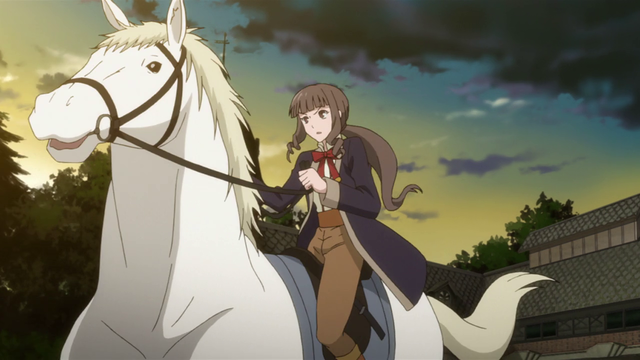
I think there was supposed to be some heartbreaking scene about the defeated detective giving up on the truth and on humanity, when he was talking to Kaishou’s daughter and she was bawling. It didn’t really strike a cord with me emotionally though, because I was busy laughing hysterically at her horse. She overhears her father’s conversation and immediately goes bounding off on her horse. When she starts crying, she nearly tramples Shinjuuro to death. She definitely lied about why she uses the horse in that earlier episode.

The horse was funny, but a bit out of place. There were a few other scenes that stood out for being great though. I especially enjoyed Inga’s appearance as a female in this episode, as she snuck up on Izumi. Izumi beats Saber for girl in suit of the season, hands down.

I also appreciated seeing everyone’s reactions to the unveiling of the truck, at the beginning of the episode. I had already concluded that the terrorist attack was an inside job, and it was nice to see Shinjuuro share my opinion. His sigh here was more expressive than any words could have been. The contrast is even more pronounced when we have the audience applauding, Inga oohing and ahhing, and Kazamori just staring blankly ahead.

A.K.A. my own random thoughts, which are actually utterly brilliant, but I had to continue the theme in titles.
Liked this post? Leave a comment, subscribe to our RSS feed, and follow us on Twitter!

Well, exponentially greater possibilities, at least.
One of the great things about yuri (or yaoi, or, even better, bisexual characters) is that the number of possible shippings increases exponentially more with the number of characters. Let’s look at why yuri is awesome and learn a bit of graph theory while we’re at it!
First of all, how do we define a “shipping”? Generally, the term refers to a single couple: for example, I have been shipping Ringo and Shouma in Mawaru Penguindrum. However, people can ship multiple couples in a single show: for our purposes, we’ll refer to this set of pairings as a single shipping. To simplify things, we’ll assume that every character is matched to a single partner. So no threesomes or harem end.
To count how many possible pairings a show has, we’re going to construct a “love graph.” Let’s start with the basics: what is a graph? The graph G = (V, E) is a set of vertices V and a set of edges E. An edge links two vertices in the graph. So in the love graph, each character is a vertex, and edges represent possible romantic links. So (a subgraph of) the love graph for Kimikiss would look like this:

We have the love triangle surrounding Kazuki, Kouichi’s love triangle, and Eiji as Kouichi’s rival for Mai. Note that the graph is bipartite: we can divide the vertices into two sets, such that all edges in the graph cross from one set to the other, simply by picking a set of boys and a set of girls. The pairings in Kimikiss are all straight.
The number of possible shippings, then, is the number of matchings on the love graph. A matching is simply a set of edges which share no common vertex— a set of couples where nobody is two-timing.
Of course, the pairings shown on the above graph are only the ones that the show itself encourages. What if we think that Sakino and Sanada make the perfect couple? Nothing wrong with that (except that Sanada is an asshole for choosing Mai and deserves to die alone and unloved). So the graph we would consider for Kimikiss in counting the number of possible shippings has edges between every pair of characters of the opposite sex. If we permit bisexual pairings, then the love graph becomes complete: there is an edge from every character to every other character in the graph.

Your typical harem has a single male character of consequence, and n females who are interested in him. How would this love graph look?
It would also be bipartite: the male character is linked to every female character, and there are no links between the female characters. If the graph has n females, then, the love graph has n possible matchings, and there are n possible shippings. Note that no perfect matching exists in the harem love graph: n-1 females must die alone and unloved. This is their lot, and we shall shed no tears for them.
Now let’s consider shows like Kimikiss and ef, where we have a similar number of males and females. Assume there are n characters, with an equal number of males and females. In this case, a perfect matching exists: to simplify things, we’ll count only the number of perfect matchings, where every character is part of a couple. Once again, the love graph is bipartite, with two fully interconnected vertex sets of size 


Next, consider a yuri / yaoi / bisexual show such as Yuruyuri or Simoun, with a cast of n characters, any two of which are a potential item. Now our love graph is complete: every character can form a couple with every other character. Once again, we’ll count the number of perfect matchings. Assuming n is even (which it must be for a perfect matching to exist) we can determine that the number of perfect matchings is 
To summarize:

So, the number of characters being equal, a show where the genders are evenly distributed has 

times as many possible perfect matchings as a heterosexual show.
So there we have it. Yuri is awesome, a realm of exponentially greater possibilities. Q.E.D.
Liked this post? Leave a comment, subscribe to our RSS feed, and follow us on Twitter!

This… has got to be the strangest piece of fanservice I’ve seen in a long while. What the heck, goat?
Overall, this episode took a step back, slowed down and took a closer look at the characters over dinner and a planning session.
This whole episode was screaming yuri. First we have Fam and Millia sharing a bed.

Then we had this onboard the ship:

Ah, so many possibilities!
We’re also back to more fanservice, like the first episode: we have Fam and Millia in their undergarments, Millia failing to put on Giselle’s shirt, and that goat. It wasn’t nearly as jarring as the first episode, however.

The slower parts were enjoyable. This show has this cutesy feel to it that’s hard to explain: it manages to look childish and cute, but also seem somewhat mature at the same time.

The real highlight for me is the action though. That vanship chase and attempted capture were pretty exhilarating. The creators know how to do this right. Many shows (*cough cough* Shana) think an exciting action sequence involves people staring at each other and shouting out their motivations and the names of their next move.
But no, the exciting thing about action shows is that anything could happen next: a moment’s difference in timing can mean the difference between life and death. In this episode, see the vanship’s entry into the ship as it submerged, for example, and Fam and Giselle nearly drown. Also the midair fight between the two vanships: that was pretty exciting.
I will say though, I found the portrayal of the Silvana a bit off-putting. They’re supposed to be a world renowned ghost ship. And their captain has to fly out personally to deal with a single unarmed vanship after they’re blinded? A bit of a disappointment: I’d have expected them to be at least mildly competent. But whatever, it is more exciting this way.

Finally, a quick update: we now have a Google+ page. Follow us here!
Liked this post? Leave a comment, subscribe to our RSS feed, and follow us on Twitter!