Dog Days 09 — Battle Princess

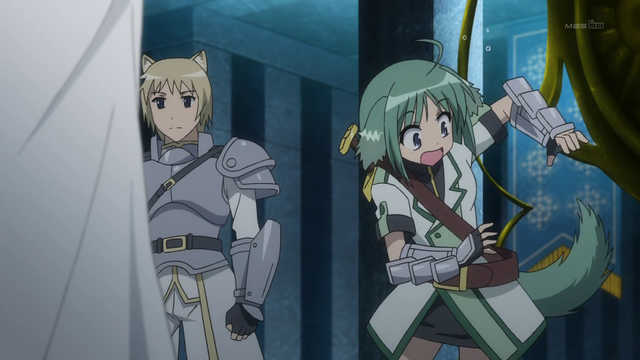
This was a battle episode so things picked up, but it still just wasn’t as fun as the first few episodes. The main problems are all these prophecies and the drama with the princess. It is impossible for this show to convince me that the princess has any chance of dying. And if she did die I would probably just break down laughing. I think the show would be vastly improved by either eliminating the princess entirely or at least making her funny. Seriously, why so serious?

I think another issue may be that the way the creators present the story is rather formulaic. The announcers say something (usually something which is painfully obvious), they shift the camera to a new two minute battle, rinse, repeat. They also have the same painfully formulaic setup whenever a character goes somewhere (e.g., Riko above). She says “I’m heading out” as they waste ten seconds with watching her leave. All in all the show just does not flow smoothly. It feels like a bunch of two minute segments glued together.

In other news, the ninja squad got taken out by some random small fry this episode since they ran out of characters from Biscotti. Anyway, have some Eclair fanservice.

Hanasaku Iroha 09 — Ohana’s Rival Appears?

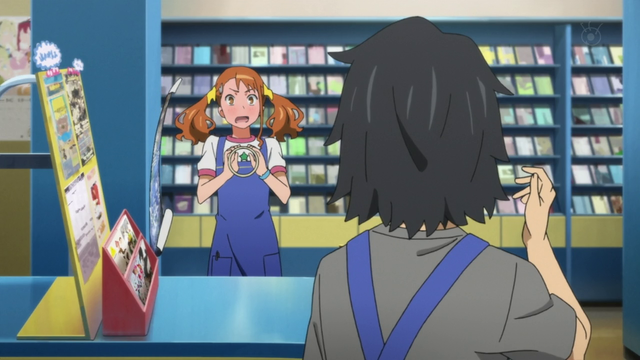
Am I reading too much into it, or will this new girl who made her appearance at Ko’s job become Ohana’s love rival? Considering that she took up the ending splash screen, she’ll likely have a role of some importance.

Ko was kind of pathetic in this episode though. He went all the way there, only to turn around and come home at the train station when the inn was out of rooms. You would think he would call before he went. Or, having arrived, he would at least look for another inn to stay at. It’s partially Ohana’s fault though, since she is pretty oblivious. And Ko just can’t keep up with her pace at all.

Minchi is making progress towards becoming a cook, due to necessity. I think she would be quite jealous of Ohana if she knew everything that happened between her and Tohru.

In the grand scheme of things, I don’t feel like much has changed from this arc though. Minchi has started cooking, and we have a greater appreciation for the manager’s bookkeeping skills. Ohana has gained a boost of confidence (not like she needed one), but otherwise this seemed like a reset ending where everything is back to how it used to be. It was an entertaining set of episodes, to be sure, but I’m most looking forward to the point in this show where the plot gets moving again.

C: The Money of Soul and Possibility Control 07 — Sick Little Sisters and Kissing Your Future

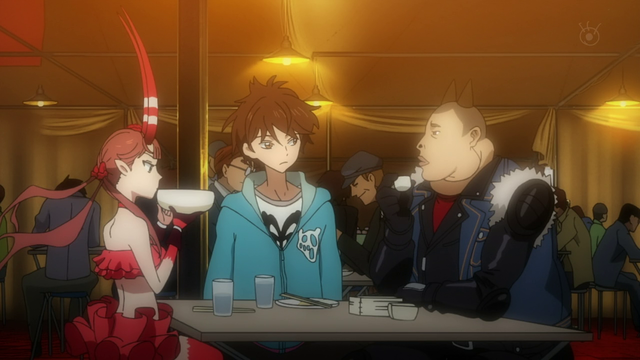
This episode took a step in the right direction by focusing on Mashu, who has so far not had much of an opportunity for development. The time spent in this episode helped, but she still feels rather bland as a character. She was born only recently, and assets are usually treated as only property, so I suppose that her underdeveloped personality makes sense. She is much more likable than a certain other newborn, at least. But honestly, she and Kimimaro both just sort of bore me. The budding romance between them definitely isn’t helping matters. Falling in love with your own future is rather narcissistic.

The earlier half of the episode focused on Souichiro’s past, who abandoned his musical ambitions to learn business from his father. His little sister was sick in the hospital, and went into a coma after Souichiro’s father went bankrupt, partially because his father wouldn’t spend the money to bring her to a better hospital.

Souichiro at least has an interesting backstory, and does something besides walking around being indecisive. Maybe he should be the main character instead of Kimimaro. But there’s one thing that bothers me about Souichiro: his voice. I’m not sure why. I usually don’t have any problems with character’s voices (unless they’re squeay little girls like Aria). But somehow Souichiro’s voice just doesn’t seem to fit his character. He always sounds so relaxed and smooth, which doesn’t really fit my image of him (or wouldn’t if it weren’t for his voice).

There are only four episodes left, and I can’t really see how this is going to resolve in that time frame. Mainly because there isn’t any conflict. I gather that there’s supposed to be some kind of abstract philosophical decision between the present and the future, but this all just seems kind of silly to me. Obviously you would want to have both a present and a future. Maybe the final boss will be the past, who feels left out. This could explain why he’s stealing all the skyscrapers from the present.

Ano Hana 07 — Sensitivity Issues

Jinta, you jerk! Way to rub it in for poor little ghost girls!

As Menma points out, though, Jinta actually is pretty cool. He still hasn’t been able to return to school, sure, but that doesn’t mean he stays cooped up in his room all day. He isn’t as ridiculously hopeless as Welcome to the NHK’s Satou or Chaos; Head’s Takumi, which I feel makes him more believable as a character. He actually is working hard to grant Menma’s wish.

Still, I kind of doubt that launching the rocket is Menma’s wish. It’s probably related to the meeting which she was keeping a secret from Jinta. If that’s the case, then Jinta may be the one person who is uniquely unqualified to grant Menma’s wish.

Anaru continues to make progress with Jinta, reaching a first name basis with him once again. Unfortunately her attempted rape is interrupted by Poppo. She doesn’t seem to have the best of luck.

Americans Eat Things Besides Hamburgers

And by “things besides hamburgers”, I don’t mean “hot dogs and french fries”.  This came to mind while watching the  latest episode of Hidan no Aria, where this billboard appeared:

As someone who has lived in Texas, I facepalmed. For readers not from the US, burgers are definitely not Tex-Mex (and certainly not this especially generic looking burger).

Not having a good grasp on American food certainly isn’t specific to anime. In real life, I work with a substantial number of people from other countries. These people will invariably complain to me that they hate American food. I ask them what foods they hate. They tell me they hate hamburgers and French fries. Occasionally they add sandwiches to the list. I don’t bother explaining that sandwiches aren’t actually from America.

On further interrogation, it turns out that they haven’t eaten anywhere except cheap restaurants, which where I live are all either sandwich shops or Chinese restaurants. I try to explain that Americans do cook things beside sandwiches and Chinese food at home, which are only found in sit-down restaurants, if at all. My friends from Asia are shocked to hear that many Americans think everyone cooks rice in a pot on the stove, in the rare case that they cook rice at all, and have never even heard of a rice cooker. Visitors from overseas then ask: well, then, what is American food?

And then I’m stumped. I list a few things off the top of my head: barbecue, Tex-Mex, southern food, potatoes, corn… They walk away pretending to be convinced. But no one buys it. American food is hamburgers and french fries.

The problem is that even Americans don’t know what American food is. For the sake of experiment, I’ve asked Americans to name some American foods.  Their answer is the same as mine. “Hamburgers, hot dogs… um… French fries? No wait, are those French?”

To risk sounding like an elementary school history textbook, America is a melting pot. Not the type you make Fondue in, although there are certainly American variations on that particular dish. But the type where it is a nation of immigrants, and we incorporate the foods of those immigrants into our own cuisine. Basically, a large part of American food is what we’ve stolen from everywhere else variations, changes and combinations of dishes brought to America by immigrants. Take Chinese food:  my friends from China complain that the food in Chinese restaurants here isn’t “authentic”. To which I reply that it’s authentically American. At what point do these foods cease being Italian, German, Chinese or Japanese and become American?

Of course, this thievery culinary exchange isn’t one sided. I visited Singapore last year, and at a food court my friend ordered a “Hamburger” from a “Western food” restaurant. What he got back was no hamburger that we would have conceived of. There was no bun, and it more closely resembled the dreaded salisbury steak cafeteria meal than the type of hamburger we were familiar with. It also came with a runny egg on top. Was the hamburger American or was it Singaporean? I don’t know, but my friend ate it all.

One of the aspects I find most interesting about anime is seeing how my own culture is portrayed. By experiencing a small slice of Japanese culture, I feel like I’ve been able to better understand my own culture.  What is American food? I never would have asked that question before I began watching anime: it would be like asking “what is food?”. It’s what I eat.